




Modernizing SmartRetail Mobile Apps: Streamline Strategy with the AI-Powered MoSCoW Prioritization Framework Tool
Streamline your SmartRetail mobile app modernization with an AI-powered MoSCoW prioritization tool. Categorize features and align stakeholders efficiently.
Imagine you are a project manager named Sarah, tasked with the “SmartRetail Mobile App Modernization” project. Your desk is buried under a mountain of sticky notes, each representing a “vital” feature requested by different departments. Marketing wants a complex loyalty program, IT is worried about legacy system integration, and the CEO just saw a cool augmented reality demo they want included by next month. Without a clear plan, Sarah’s project is like a ship trying to sail in four directions at once. To find her way, she needs a reliable compass—specifically, a professional AI-powered MoSCoW prioritization framework tool that can help her categorize these demands before the scope starts to creep out of control.
A MoSCoW prioritization framework tool is an intelligent application designed to help teams sort their requirements into four clear buckets: Must Have, Should Have, Could Have, and Won’t Have. By using this structured approach, project leaders can ensure that the most critical elements are delivered first, keeping stakeholders happy and budgets on track. Visual Paradigm has transformed this traditional management technique into a high-speed, AI-assisted experience that does the heavy lifting for you.
Quick takeaways for Project Success
- Focus on what matters: Clearly identify non-negotiable “Must Have” features to ensure project viability.
- AI-Driven Efficiency: Generate a complete starting list of prioritized items in seconds by providing simple project context.
- Stakeholder Alignment: Use professional reports to facilitate agreement and reduce departmental friction.
- Data Privacy: Keep your strategic project data safe by saving your analysis directly to your own computer.
- Actionable Planning: Define dependencies and responsible parties for every item, not just their priority level.
The First Step: Defining the Vision with AI
The journey begins with a simple conversation between you and the tool. Instead of staring at a blank spreadsheet for hours, you can use the built-in AI assistant to draft your initial roadmap. In our scenario with Sarah and the “SmartRetail” modernization, she simply enters her project name and the industry context—retail transitioning from legacy systems to a digital-first experience. She describes her goals, such as increasing customer engagement through online ordering and real-time inventory visibility, while noting her constraints, like a strict six-month timeline.
Once Sarah clicks “Generate,” the online MoSCoW prioritization framework tool analyzes her specific situation. It understands the complexities of the retail industry and immediately suggests a comprehensive list of tasks. This isn’t just a generic list; it’s tailored to the specific needs of an omnichannel digital transformation, covering everything from security compliance to user account systems. It feels less like using software and more like having a senior consultant sitting right next to you, outlining the strategy in real-time.

Categorizing the Essentials: The “Must Have” Requirements
After the AI does its magic, the tool guides you through a logical 5-step workflow. The first and most critical stop is Step 1: Must Have. These are the “non-negotiables.” If these features aren’t delivered, the project is considered a failure. For the SmartRetail app, the tool suggests items like “Unified Authentication & Profile Management.” It doesn’t just name the task; it provides a detailed description of syncing with legacy databases and lists the “Reason” for its priority—essential for user access and personalization.
The interface is designed like a smart table where Sarah can easily refine the suggestions. She can add “Real-Time Inventory” to the list, noting that it is critical for accurate ordering and preventing customer frustration. The table also includes columns for “Dependencies” (like backend inventory APIs) and “Responsible Party” (the Integration Team). This level of detail turns a simple list into an actionable blueprint. It’s like building the foundation of a house; you have to make sure the concrete is solid before you worry about the color of the curtains.

Balancing the “Should Have” and “Could Have” Features
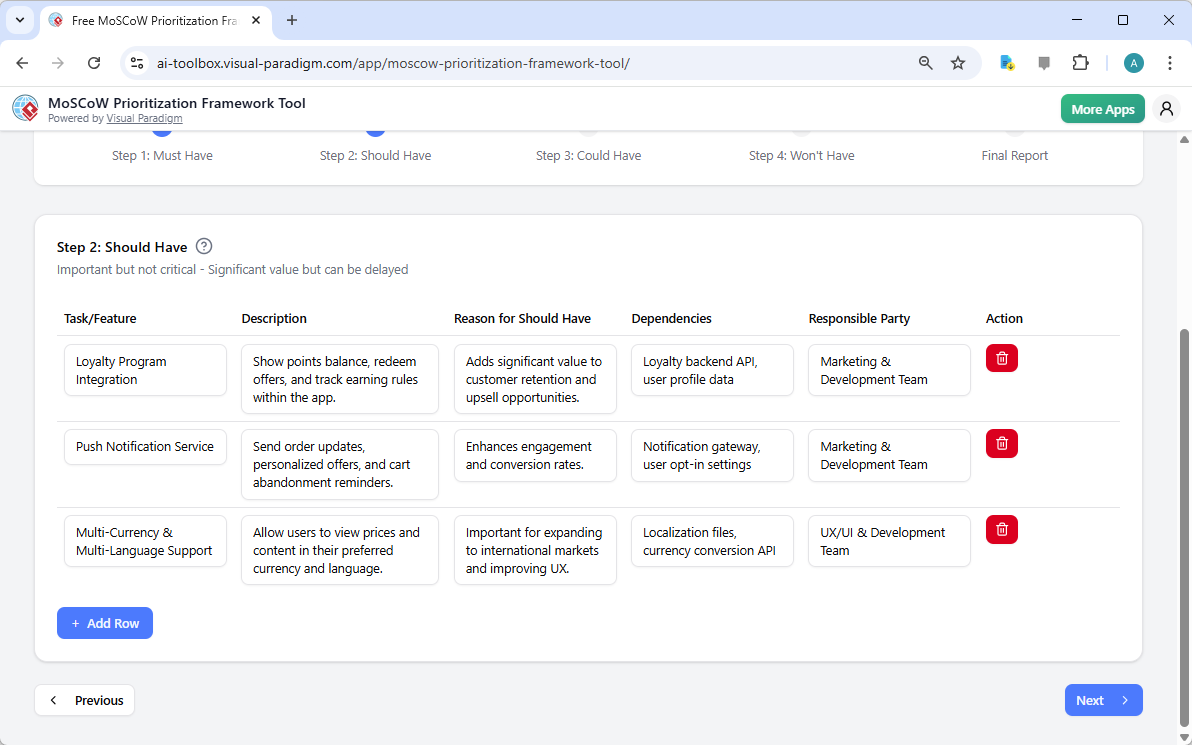
Once the foundation is set, the tool moves Sarah to Step 2: Should Have. These are features that are important and add significant value but are not strictly vital for the initial launch. In our retail example, the easy-to-use MoSCoW prioritization framework tool identifies “Loyalty Program Integration” and “Push Notification Services” as Should Haves. They are great for customer retention, but if a technical glitch delayed them by a week, the app would still function. This distinction is vital for managing stress levels during development.
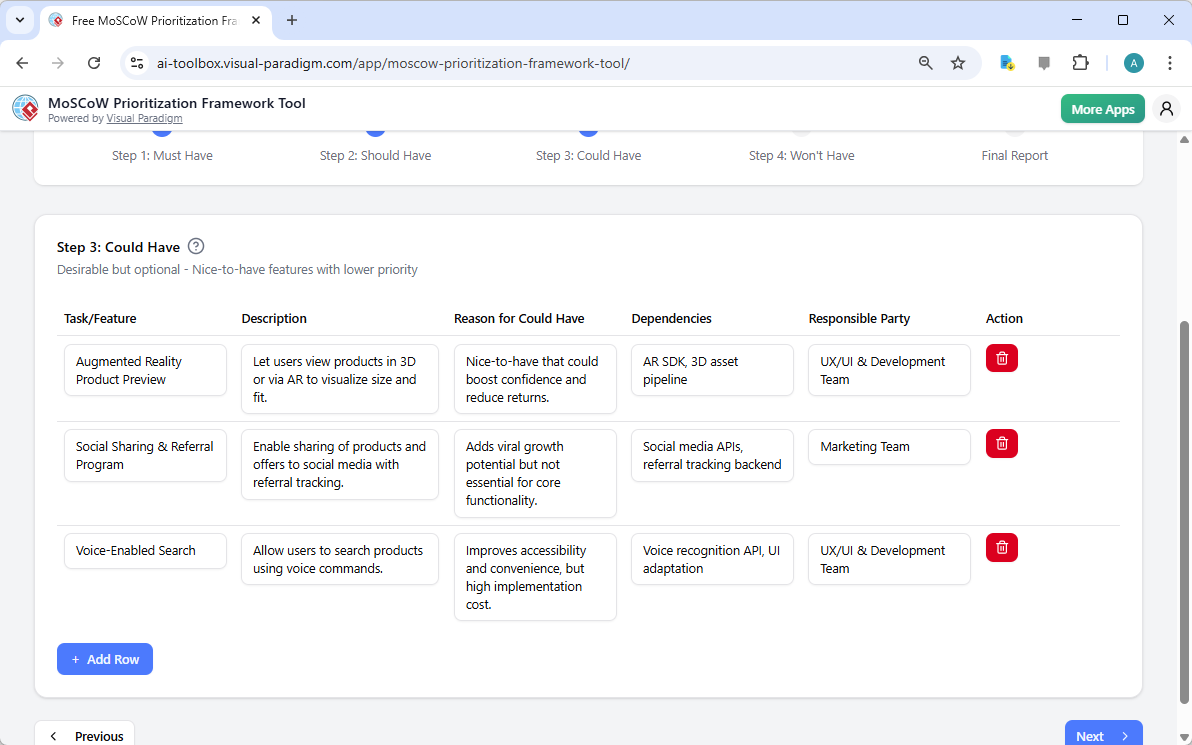
Next, we find the “Could Have” items in Step 3. Think of these as the “nice-to-haves” or the cherries on top of the project sundae. They are desirable but optional. For SmartRetail, the AI suggests “Augmented Reality Product Previews” and “Voice-Enabled Search.” These features would definitely make the app stand out in the market, but they have high implementation costs and aren’t essential for core functionality. By placing them here, Sarah acknowledges their value without letting them distract the team from the primary goal of online ordering.
Setting Boundaries: The “Won’t Have” Bucket
One of the most powerful features of any professional MoSCoW prioritization framework tool is the ability to say “no.” Step 4: Won’t Have is where you explicitly list items that are out of scope for the current phase. This prevents the dreaded “scope creep” where a project slowly expands until it becomes impossible to finish. For Sarah, this includes things like “In-App Video Gaming” or “Offline Cash-Only Checkout.”
The tool allows Sarah to document the reason why these items were excluded—for instance, that video games aren’t aligned with core retail objectives. It also includes a “Potential Future Consideration” column, ensuring that good ideas aren’t forgotten, just parked for later. It’s a polite way of telling stakeholders, “We hear you, but let’s focus on finishing the house before we build the swimming pool.” This clarity is essential for maintaining team focus and managing executive expectations.

Visualizing Success with the Final Report
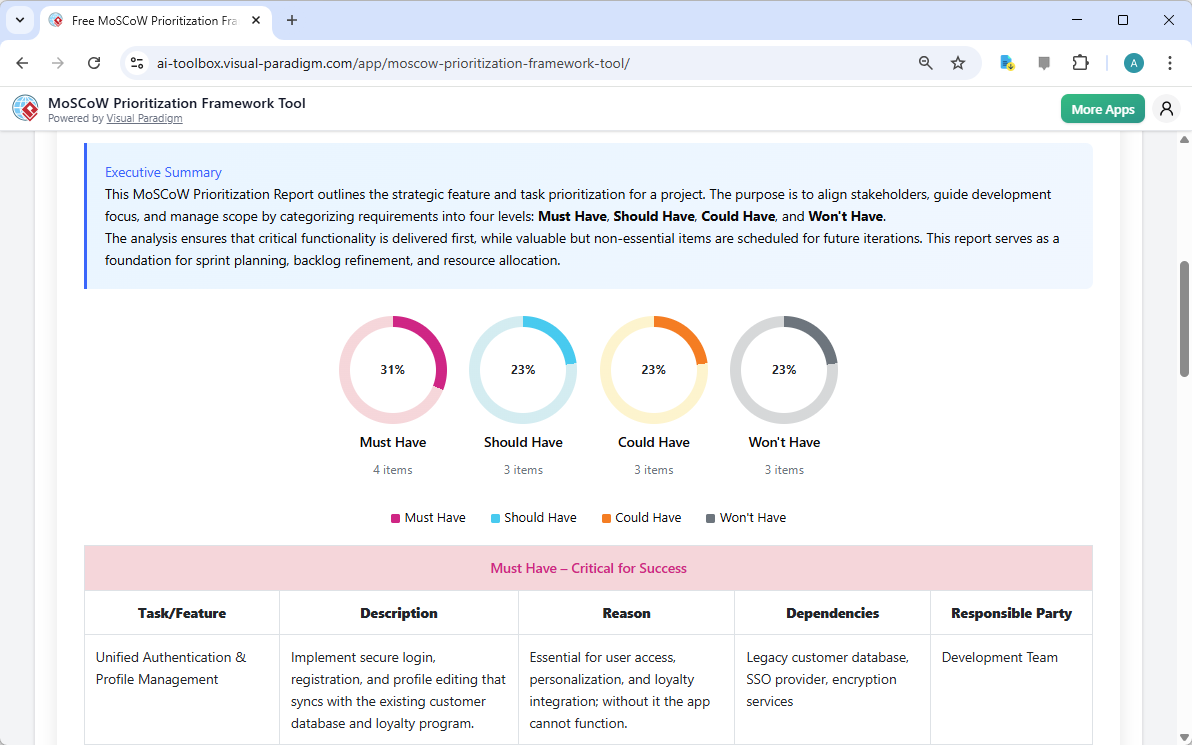
The final step of the process is the most rewarding. The tool consolidates all the data entered into a professional, easy-to-read “Final Report.” This isn’t just a boring list; it includes visual aids like circle charts that show the percentage distribution of your tasks across the MoSCoW categories. For the SmartRetail project, Sarah can see at a glance that 31% of her tasks are “Must Haves,” giving her a clear picture of the minimum viable product (MVP).
This report serves as the ultimate document for stakeholder meetings. Sarah can print it as a PDF or share it during a presentation to show exactly why certain features are being prioritized over others. Because the AI-powered MoSCoW prioritization framework tool saves all data locally as a .json file, Sarah also has total peace of mind regarding data privacy. Her strategic plans remain on her computer, not on a third-party server. When she needs to make updates later, she simply loads the file back into the tool and continues where she left off.
Conclusion: Turning Chaos into Clarity
Prioritizing project requirements doesn’t have to feel like a high-stakes game of Tetris. By using a structured best MoSCoW prioritization framework tool, you can transform a overwhelming list of demands into a logical, phased plan. Visual Paradigm’s tool takes this a step further by using AI to jumpstart your brainstorming, ensuring you never have to face a blank page alone. Whether you are modernizing a retail app like Sarah or managing a small internal team project, the clarity provided by the MoSCoW method is your best defense against project failure.
Ready to take control of your project scope and align your team? You can start building your own strategic roadmap today. Simply visit the AI-powered MoSCoW prioritization framework tool and let the AI help you define what truly matters for your success.
Try it now: Launch the MoSCoW Prioritization Framework Tool
Learn more: Explore the MoSCoW Framework Guide
Related Links
- MoSCoW method – Wikipedia: In such cases, the team could then use the MoSCoW method to select which features (or stories, if that is the subset of epics in their organisation) are Must have, Should have, and so on; the minimum marketable features (or MMF) …
- MoSCoW vs. Other Prioritization Frameworks – Visual Paradigm AI: When to use the Matrix: This framework is excellent for a quick, visual overview of your backlog. It’s especially useful for identifying features that offer high value with low effort, which are often prioritized for immediate development. MoSCoW’s advantage: The matrix can be subjective, as “value” and “effort” are not always easy to define.
- The Basics of MoSCoW – Visual Paradigm AI: Learn the fundamentals of the MoSCoW prioritization framework. Discover how the Must Have, Should Have, Could Have, and Won’t Have categories help teams align priorities, prevent scope creep, and deliver successful projects on time.
- MoSCoW Prioritization Framework Tool – Project Management & Requirements Prioritization: The MoSCoW Prioritization Framework Tool helps you prioritize project features and tasks using the Must Have, Should Have, Could Have, Won’t Have (MoSCoW) methodology .
- MoSCoW Prioritization Template | MOSCOW Method Template: Eye-catching MOSCOW Method template: MoSCoW Prioritization Template. Great starting point for your next campaign. Its designer-crafted, professionally designed and helps you stand out.
- Prioritizing Requirements with MoSCoW Method: A Guide for Agile Projects – Visual Paradigm Guides: The MoSCoW method is a prioritization technique used in project management, software development, and business analysis . It helps to prioritize requirements based on their importance and urgency, and allows project managers to allocate resources …
- How to Prioritize Product Backlog Using MoSCoW Method: The MoSCoW method (also known as MoSCoW prioritization or MoSCoW analysis) is a prioritization technique to reach a common understanding with stakeholders on the importance they place on the delivery of each requirement .
- MoSCoW Template – Visual Paradigm Online: MoSCoW Prioritization Template · MoSCoW Prioritization and Scoping See all MOSCOW Method templates · Get Started For Free · ©2025 by Visual Paradigm. All rights reserved. Terms of Service · Privacy Policy ·
- Prioritizing Success: A Journey through MoSCoW in E-Commerce Development – Visual Paradigm Guides: In this scenario, we explore how a software development team utilizes the MoSCoW method to prioritize features for a new e-commerce platform, ensuring the delivery of a robust and functional product within tight deadlines.