




Building a Winning SaaS Strategy: A Full Market Analysis Guide with Visual Paradigm’s Competitive Analysis Tool
Learn how to build a winning SaaS strategy using Visual Paradigm's AI competitive analysis tool to benchmark against Asana and Monday.com.
In the hyper-competitive landscape of B2B software, launching a new product without a clear understanding of the battlefield is a recipe for failure. For product managers and entrepreneurs in the SaaS space, specifically those entering the crowded Project Management Software market, precision is everything. Visual Paradigm’s AI-powered competitive analysis tool offers a sophisticated, streamlined solution to this challenge. By transforming vague business ideas into data-driven strategies, this online strategic planning software allows you to benchmark against giants like Asana and Monday.com in minutes rather than weeks. This guide walks you through a real-world scenario of analyzing the SaaS project management sector to uncover hidden market gaps.
Quick Summary: Key Takeaways
- Accelerated Intelligence: Use AI to instantly generate a comprehensive analysis framework based on your specific industry context (e.g., SaaS Project Management).
- Structured Workflow: Follow a professional 6-step wizard that guides you from defining objectives to actionable recommendations.
- Deep Benchmarking: Compare pricing models, feature sets, and integration ecosystems against top-tier competitors like Asana and ClickUp.
- Data Privacy: All strategic data is saved locally to your device, ensuring your proprietary research remains confidential.
- Actionable Outcomes: The tool doesn’t just list data; it helps synthesize findings into concrete strategic moves, such as pricing adjustments or feature roadmap changes.
Kickstarting Your Strategy with AI Generation
The hardest part of any competitive market analysis is often the blank page—knowing where to start. Visual Paradigm solves this by integrating generative AI directly into the workflow. In our example scenario, a user wants to launch a cloud-based project management platform tailored for small to mid-sized teams. Instead of manually brainstorming research parameters, the user simply inputs the industry (“SaaS – Project Management Software”) and a brief business description into the AI prompt.
This automated business analysis tool uses this context to construct a tailored research framework. It anticipates the nuances of the SaaS market, preparing to identify key rivals, pricing positioning, and critical feature gaps. It feels less like using software and more like consulting with a seasoned market analyst who immediately understands your sector.

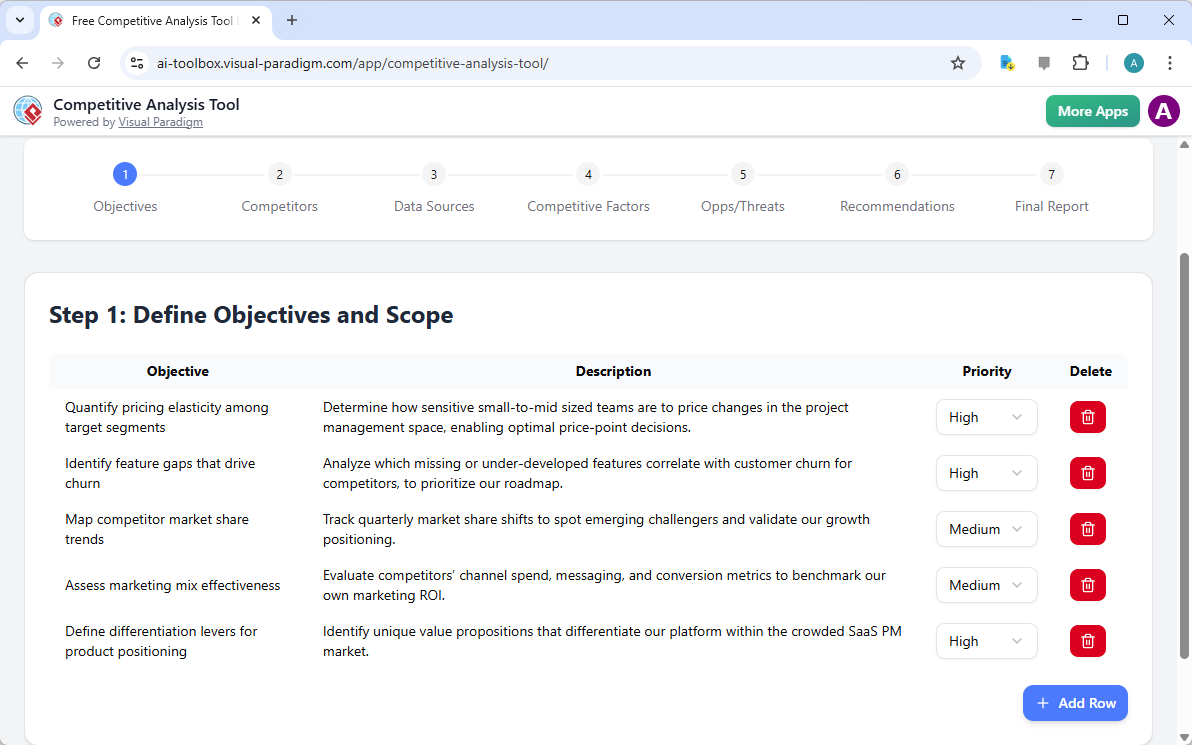
Once the AI processes the prompt, it instantly populates the first step of the wizard: Defining Objectives and Scope. The tool goes beyond generic goals, suggesting high-impact objectives specific to the SaaS domain. As seen in the generated table, the AI has identified critical goals such as “Quantify pricing elasticity among target segments” and “Identify feature gaps that drive churn.”
These aren’t just placeholders; they are strategic pillars. For instance, understanding “differentiation levers” is crucial when competing against established players. The table is fully interactive, allowing you to edit priorities or add custom objectives, ensuring the analysis aligns perfectly with your specific business goals.
Mapping the Competitive Landscape
With objectives set, the next logical step is identifying who you are up against. The competitor tracking features of the tool automatically populate a list of the most relevant players in the industry. In our project management example, the tool has correctly identified the market leaders and challengers: Asana, Monday.com, ClickUp, Trello, and Basecamp.
This categorization is vital for a SWOT analysis. It distinguishes between “Market Leaders” (Asana) and “Rapid Growth Challengers” (ClickUp), helping you understand who dominates the enterprise space versus who is capturing the SMB market. You can easily add niche competitors or remove irrelevant ones using the intuitive table interface.

Sourcing Reliable Market Intelligence
Data is only as good as its source. Step 3 of the wizard, Gather Data, ensures your research is grounded in reality. The tool suggests specific data types and the best channels to retrieve them. For a SaaS product, this includes checking “Pricing” via public pricing pages, analyzing “Features” through comparison sites like G2 and Capterra, and estimating “Market Share” via reports from Statista or Gartner.
This structured approach prevents “analysis paralysis” by giving you a checklist of exactly what information to hunt for. It reminds you to look at “Customer Reviews” to scrape sentiment—a goldmine for finding competitor weaknesses—and to track “Marketing Spend” to understand how rivals are acquiring users.

Deep-Dive Benchmarking: Pricing and Features
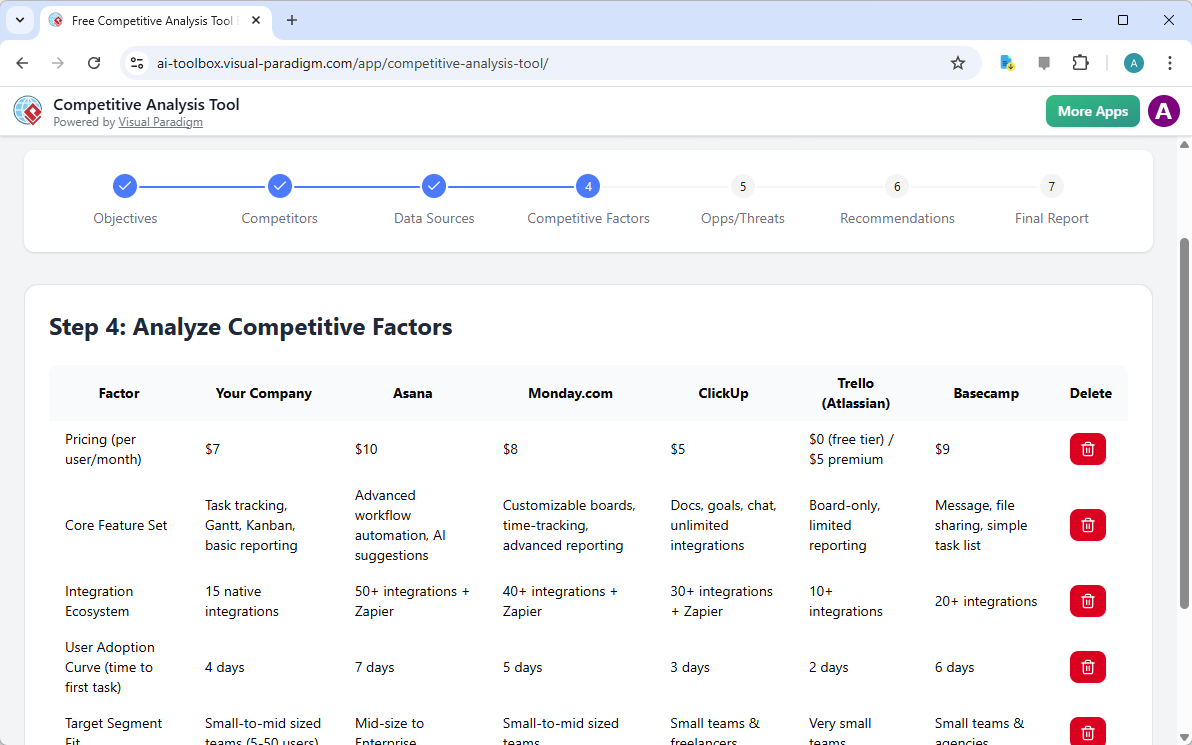
Step 4 is the core of the analysis: Analyze Competitive Factors. Here, the tool facilitates a side-by-side comparison of your company against the identified competitors. In the visual below, we see a detailed breakdown of pricing models and core feature sets. For example, the analysis highlights that while Asana charges $10/user/month, ClickUp aggressively undercuts at $5/user/month.
This grid view is essential for identifying your market positioning. If your proposed price is $7, you are positioned as a mid-range option. The table also compares “User Adoption Curve” and “Integration Ecosystems,” revealing that while competitors have vast integration libraries, they may suffer from slower onboarding times (e.g., Asana taking 7 days to first task). This insight exposes a potential competitive advantage: speed and simplicity.
Synthesizing Opportunities and Threats
Raw data must be translated into strategic insight. In Step 5, the tool guides you to Identify Opportunities and Threats based on the data collected. The analysis reveals a high-impact opportunity: “High demand for lightweight, affordable PM tools in the 5-20 user segment.” This directly correlates to the complexity observed in competitors like Asana.
Conversely, it highlights a significant threat: “Competitors’ aggressive discounting,” noting ClickUp’s strategy. The tool allows you to map these factors to specific competitors and assign impact levels. This step transforms the competitive intelligence into a risk assessment matrix, helping you decide where to attack and where to defend.

Formulating Strategic Recommendations
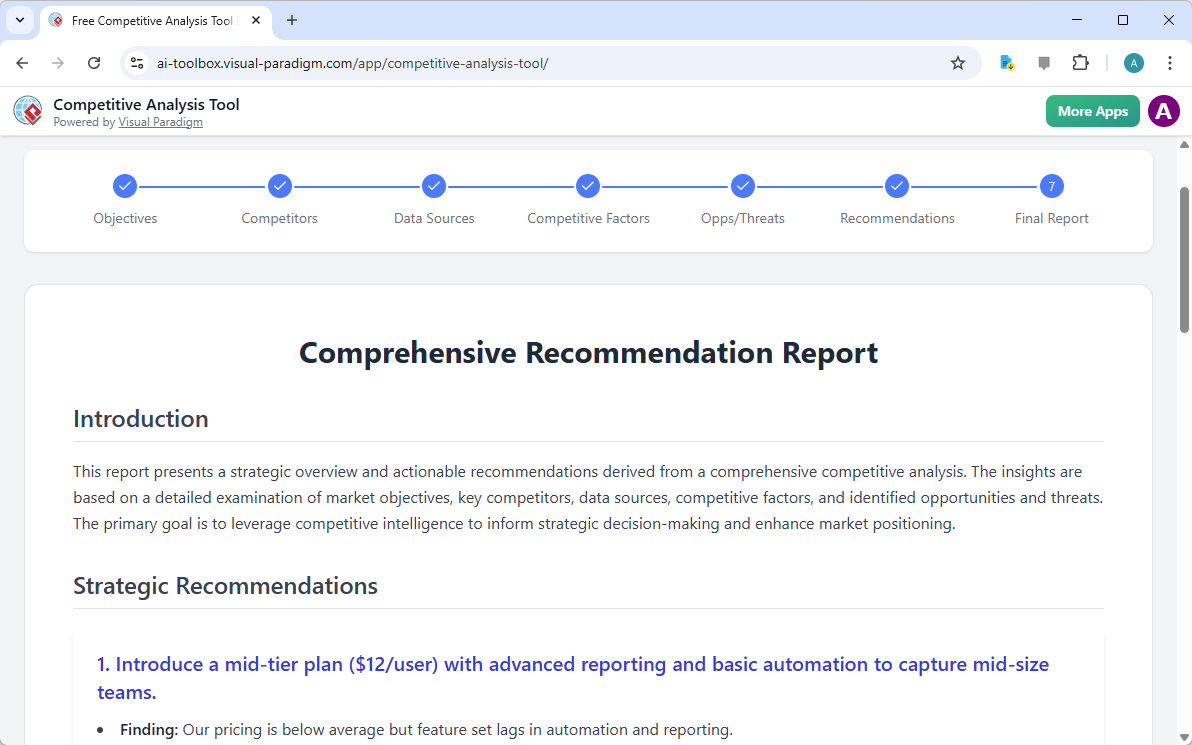
The ultimate goal of any analysis is action. Step 6, Summarize and Recommend Actions, bridges the gap between insight and execution. Based on the findings—specifically that “pricing is below average but feature set lags in automation”—the tool suggests a concrete recommendation: “Introduce a mid-tier plan ($12/user) with advanced reporting.”
It also addresses the onboarding issue identified earlier. Since freemium adoption rates are low due to slow onboarding, the recommendation is to “Redesign onboarding with interactive tutorials.” These are not vague suggestions; they are specific, timeline-bound strategic initiatives linked directly to the objectives defined at the start.

The Final Deliverable: A Professional Strategic Report
After completing the 6-step wizard, the online competitive analysis tool compiles every data point, insight, and recommendation into a consolidated Comprehensive Recommendation Report. This document serves as a single source of truth for your strategy. It presents the introduction, strategic recommendations, and supporting data in a clean, readable format suitable for presentation to stakeholders or investors.
You can save this report as a PDF or keep the editable project file locally. This capability ensures that your strategic planning is not a one-time event but an evolving document that grows with your business.
Conclusion
Entering a saturated market like SaaS Project Management requires more than just a good product; it requires a superior strategy. Visual Paradigm’s Competitive Analysis Tool provides the framework, the AI-powered speed, and the analytical depth required to find your winning angle. By systematically dissecting competitors’ pricing, features, and weaknesses, you can craft a roadmap that avoids threats and capitalizes on underserved market needs.
Ready to define your competitive edge? Try the Competitive Analysis Tool now and start building your market strategy today.
Related Resources
- AI Competitive Analysis Tool – Gain Strategic Market Insights: November 11, 2025 – Uncover actionable market insights with our AI Competitive Analysis Tool. Analyze competitors’ strategies, strengths, and weaknesses using AI to stay ahead in your industry.
- Competitive Analysis Tool – Visual Paradigm: The Competitive Analysis Tool delivers outputs that seamlessly integrate into your strategic planning process: Comprehensive Competitor Profiles: Organized insights on each competitor’s strengths, weaknesses, and strategies. Side-by-Side Comparisons: Visual comparisons that highlight where your business leads or lags.
- Competitive Analysis Tool Review: AI-Driven Market Strategy: Unlocking Strategic Insights with AI In today’s saturated market, understanding your competitive landscape is not just a luxury; it is a necessity for survival. Business strategists, product managers, and entrepreneurs often struggle with the organization and synthesis of market data. Enter the Visual Paradigm Competitive Analysis Tool , a strategic application designed to transform scattered …
- How It Works – Competitive Analysis Tool – Visual Paradigm AI: Learn how the Competitive Analysis App transforms raw data into a strategic action plan. Discover the workflow, from gathering real-world insights to generating a comprehensive, actionable report for your team.
- Free AI Competitive Analysis Tool for Business Strategy – Visual …: Understand your market and outperform the competition with our free AI competitive analysis tool . A step-by-step guide to a comprehensive analysis .
- Your First Steps with a Competitive Analysis Tool – Visual Paradigm AI: Discover how to begin competitive analysis with our easy-to-use tool . Learn to define objectives, identify competitors, and gather key insights today!