




Revolutionizing EdTech Strategy: Implementing AI-Driven Learning via the Professional Force Field Analysis Framework Tool
Master EdTech change with our AI-driven Force Field Analysis tool. Evaluate progress vs. inertia to implement personalized learning platforms effectively.
Navigating the turbulent waters of organizational change requires more than just a compass; it demands a high-precision strategic radar. For visionaries at EduSphere Learning, the transition to an AI-powered personalized learning platform represents a monumental shift in the EdTech landscape. To manage such a transition, leaders are turning to the professional Force Field Analysis Framework tool, an innovative solution designed to deconstruct complex initiatives into manageable variables. By meticulously evaluating the equilibrium between progress and inertia, this tool empowers decision-makers to transform abstract goals into concrete, actionable success stories with unprecedented speed.
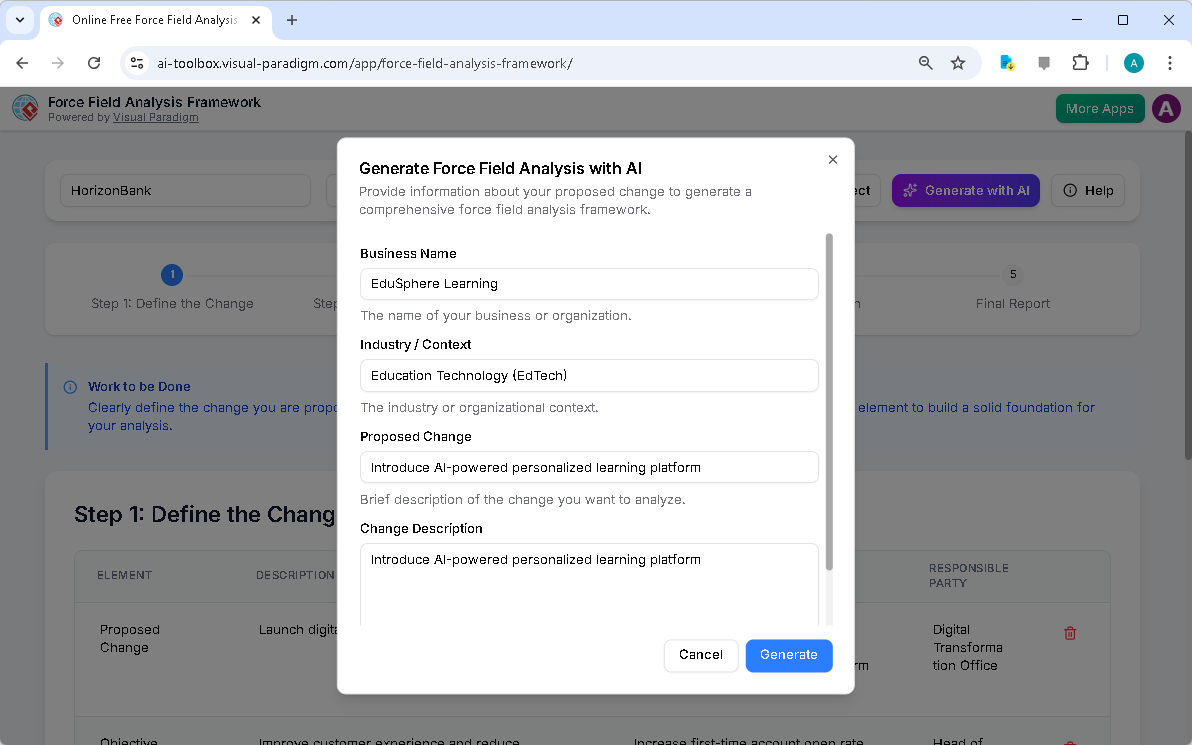
The process begins with a sophisticated AI interface that acts as your personal change management consultant. Imagine providing a brief description of your business and your proposed innovation, only to have a comprehensive analytical structure appear before your eyes. In our example with EduSphere Learning, the user inputs the “Industry Context” as Education Technology and describes the “Proposed Change” as a deployment of an AI-driven system. This initial interaction bridges the gap between raw intent and structured analysis, providing a robust foundation for the journey ahead.
Quick Takeaways: Why Use an AI-Powered Strategic Analysis?
- Accelerate Strategy Development: Leverage high-speed AI to generate comprehensive first drafts of your change initiatives in seconds.
- Quantify Qualitative Factors: Assign numerical strength ratings (1-5) to prioritize the most impactful forces affecting your project.
- Ensure Data Sovereignty: Maintain 100% privacy by saving your strategic data as local .json files rather than on a cloud server.
- Enhance Stakeholder Alignment: Generate professional, consolidated reports that clearly communicate the “why” and “how” of your strategy.
- Develop Balanced Action Plans: Systematically create strategies to strengthen driving forces and mitigate restraining ones.
Defining the Blueprint: Step 1 of the Change Wizard
The easy-to-use Force Field Analysis software utilizes a structured 5-step wizard that demystifies the methodology developed by Kurt Lewin. The first critical phase is “Define the Change.” This is where the AI populates an interactive dynamic table with essential elements such as Objectives, Scope, and Timelines. For EduSphere, the AI correctly identifies that the objective is to improve learner outcomes by 15% through personalized instruction, with a phased deployment planned through 2027. This level of granularity ensures that every stakeholder understands the boundaries and goals of the mission.
Using these interactive tables feels remarkably intuitive, akin to editing a high-performance spreadsheet. Users can refine AI-generated descriptions or add specific details unique to their organization. By assigning a “Responsible Party” to each element, the tool transforms a theoretical plan into a roadmap of accountability. This clarity is the first step in dismantling the ambiguity that often plagues large-scale organizational shifts, ensuring the “what” and “when” are beyond reproach.

Harnessing the Momentum: Identifying Driving Forces
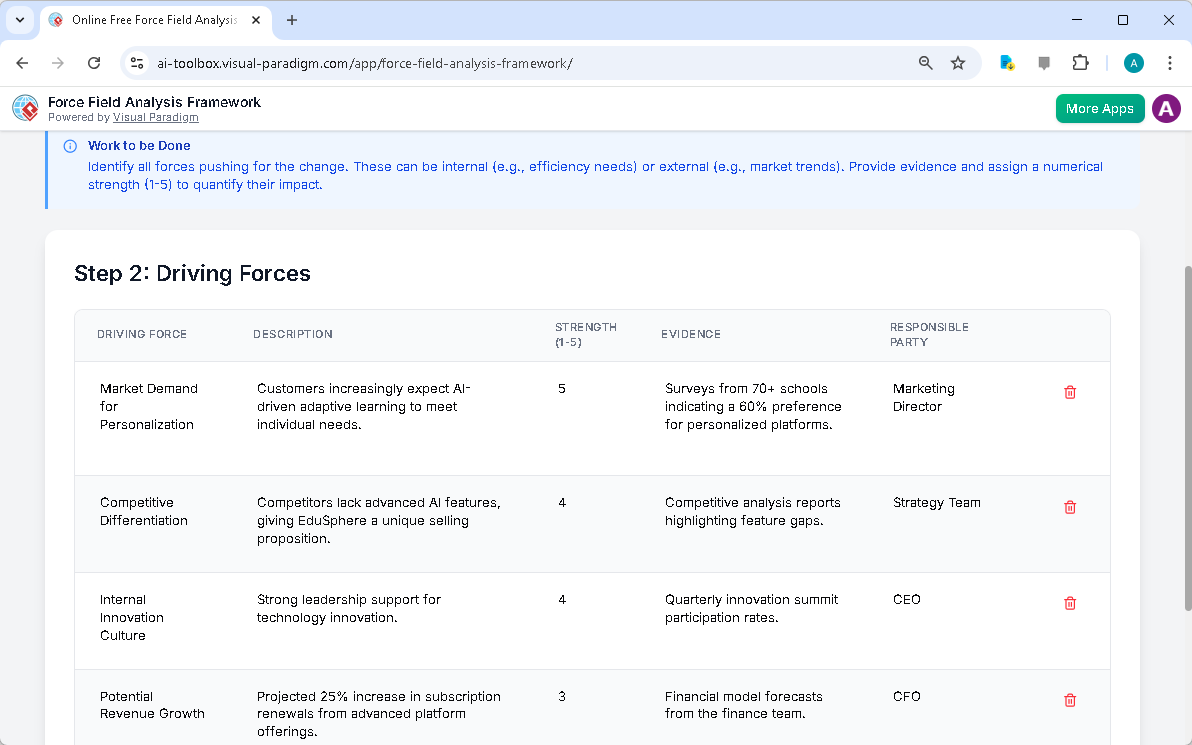
Once the change is defined, the focus shifts to Step 2: Identifying Driving Forces. These are the catalysts—the factors pushing your organization toward its future state. In the context of EduSphere Learning, the best online Force Field Analysis app identifies key drivers such as “Market Demand for Personalization” and an “Internal Innovation Culture.” These aren’t just labels; they are quantified variables. The tool allows you to assign a “Strength Rating” from 1 to 5, providing a visual and mathematical representation of which factors are most likely to propel the project forward.
The beauty of this AI-powered strategic analysis tool lies in its ability to synthesize evidence. For instance, it notes surveys from over 70 schools as evidence for market demand, giving the strategy empirical weight. When you see a “5” assigned to market demand, it signals to the executive team that the external environment is primed for this change. This quantification is vital for prioritizing where to double down on marketing or internal communication efforts to maintain momentum.
Confronting the Resistance: Analyzing Restraining Forces
No significant change occurs without friction. Step 3 of the wizard focuses on Restraining Forces—the obstacles that could potentially derail your progress. For EduSphere, the professional change management tool highlights “Data Privacy Compliance” and “Technical Integration Complexity” as significant hurdles. By identifying these early, a project manager can move from a reactive stance to a proactive one. Acknowledging that regulations like GDPR and FERPA carry a strength rating of 5 allows the team to allocate the necessary legal and technical resources before they become critical bottlenecks.
The realistic assessment of these forces is what separates successful leaders from those who fall victim to “strategic optimism.” The tool’s layout forces a no-nonsense evaluation of resource constraints and internal resistance. By documenting the evidence for these obstacles—such as current staffing analysis or audit findings—the organization builds a transparent case for the investments needed to overcome them. It’s about facing the “friction” head-on with calculated precision.

Formulating the Action Plan: From Analysis to Execution
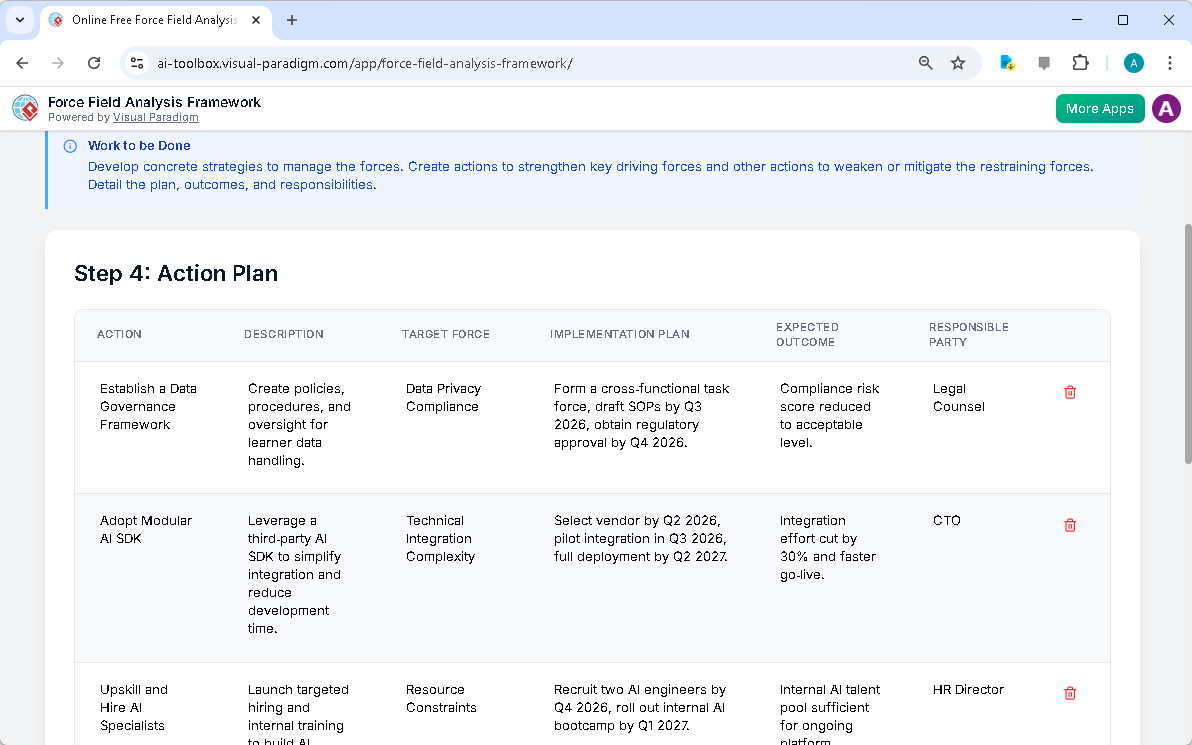
The most profound analysis is worthless without execution. Step 4, the “Action Plan,” is where the Force Field Analysis Framework truly shines. It takes the driving and restraining forces identified in the previous steps and challenges the user to develop concrete strategies. For every restraining force like “Data Privacy,” the tool suggests actions such as “Establish a Data Governance Framework.” It includes implementation plans, target dates (e.g., Q3 2026), and expected outcomes, such as reducing the compliance risk score to an acceptable level.
This phase is where the “tug-of-war” is won. The objective is twofold: amplify the driving forces and diminish the restraining ones. For EduSphere, this means upskilling internal talent to solve resource constraints while adopting modular SDKs to bypass integration complexity. The sophisticated rhythm of this workflow ensures that every strategic insight leads directly to a task on someone’s calendar. It transforms a high-level vision into a series of achievable, tactical victories.
The Executive Verdict: Consolidating the Final Report
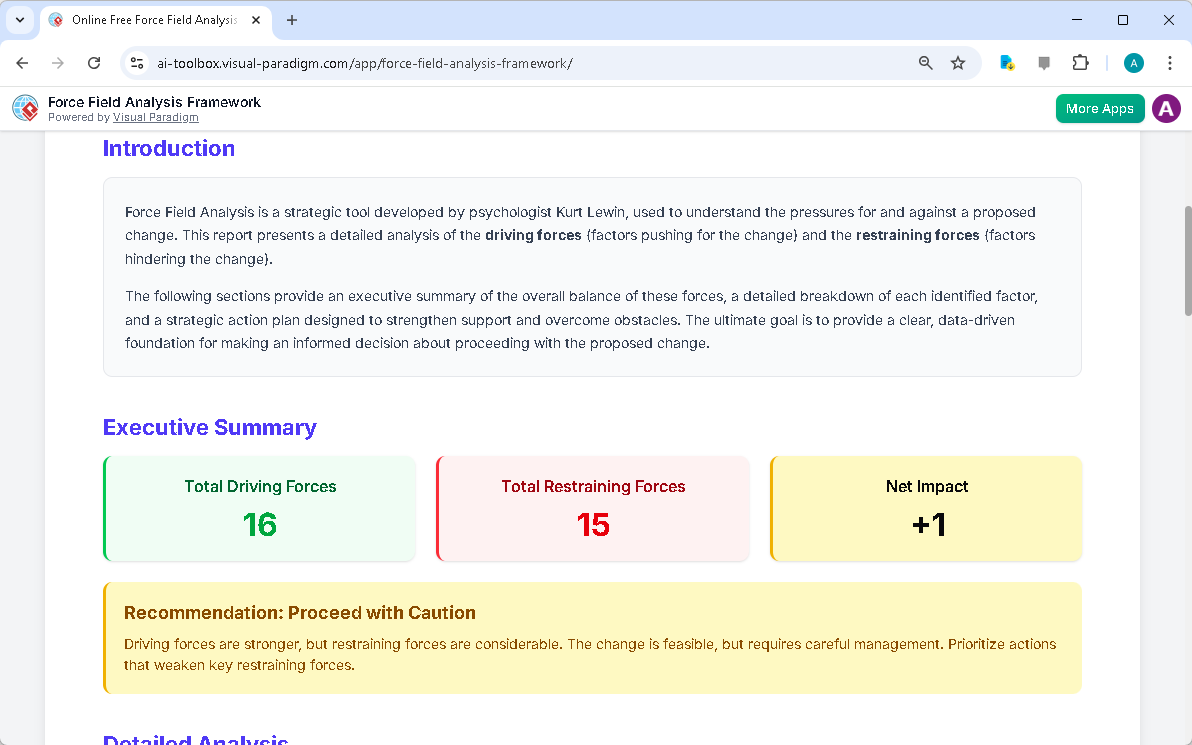
The culmination of the 5-step process is the “Final Report.” This section provides a high-level executive summary that aggregates all data into a single, professional document. The report calculates the “Net Impact” by weighing the total strength of driving forces against restraining forces. In our EduSphere example, the tool shows 16 driving points versus 15 restraining points, leading to a recommendation of “Proceed with Caution.” This balanced perspective is exactly what business leaders need to make informed, data-driven decisions.
This consolidated report is perfect for presentation to boards or leadership teams. It offers a clear visual and textual summary, making it easy to communicate the complex dynamics of the AI platform rollout. Furthermore, the professional Force Field Analysis Framework tool ensures your strategic data remains confidential. By using the “Save Project” feature, the entire analysis is stored on your local machine, giving you total ownership of your intellectual property without the risks of cloud storage. To share, simply print to PDF and distribute your roadmap to success.
Conclusion: Embrace the Future of Change Management
In the fast-paced world of EdTech and beyond, the ability to pivot and evolve is the ultimate competitive advantage. Visual Paradigm’s AI-powered Force Field Analysis Framework provides the structure, speed, and sophistication required to navigate these shifts successfully. From the initial AI-generated brainstorm to the final executive report, every step is designed to maximize your probability of success. Stop guessing about the impact of your initiatives and start measuring them with professional-grade precision.
Are you ready to lead your organization into its next chapter with confidence? Experience the power of structured, AI-assisted strategic planning today. Whether you are a project manager, a business executive, or a consultant, this tool is your key to unlocking effective change management.
Try the Force Field Analysis Framework now: Launch the AI-Powered Analyzer
To learn more about how Visual Paradigm can elevate your strategic workflows, visit our detailed guide: Force Field Analysis Framework Product Page.
Related Links
- Force Field Analysis Tool: Perform Force Field Analysis fast. Creating force field model has never been easier. Visual Paradigm force field analysis tool provides a wide range of unique templates and features to help you create beautiful and professional force field diagrams in minutes.
- Visual Paradigm AI vs. General LLMs: Comprehensive Modeling Guide: Visual Paradigm AI (VP AI ): A specialized AI engine integrated directly into the Visual Paradigm software suite.VP AI Advantage: Visual Paradigm ’s AI is constrained by a built-in rules engine. It validates outputs against official specifications before presenting them to the user.
- Visual Paradigm’s AI Strategic Analysis Tool for Force Field Analysis: 12 Sept 2025 · Visual Paradigm helps you list each of these, describe them, and even assign a strength score. This step transforms vague ideas into concrete …
- Force Field Analysis Framework – Visual Paradigm AI: Use our free Force Field Analysis framework to evaluate driving and restraining forces of change. Build clarity, assess risks, and create actionable …
- Free AI Force Field Analysis Tool for Change Management – Visual …: This intelligent wizard helps you identify the forces pushing for and resisting change, allowing you to develop effective strategies for successful …
- Force Field Analysis Framework | A Change Management Tool – Visual Paradigm: The Force Field Analysis Framework is a strategic web-based tool used to understand the pressures for and against a proposed change.
- How It Works – Force Field Analysis Framework – Visual Paradigm AI: This free tool is designed to guide you through a proven four-step workflow, turning your real-world insights into a concrete action plan. But before you even …