




Optimizing Product Refund Policies: AI-Driven Logic Design with Decision Table Generator
Learn how to use Visual Paradigm’s AI Decision Table Generator to automate product refund policies, reduce errors, and streamline business logic design.
In the complex landscape of business operations, establishing clear, unambiguous rules is essential for maintaining consistency and customer satisfaction. Nowhere is this more critical than in managing product return and refund policies, where multiple variables—such as the reason for return, the time elapsed since purchase, and customer loyalty status—must be weighed simultaneously to determine the correct outcome. Visual Paradigm’s AI-powered Decision Table Generator offers a sophisticated solution to this challenge, allowing business analysts and project managers to transform narrative policy descriptions into rigorous, executable logic structures effortlessly.
This professional online tool leverages advanced artificial intelligence to streamline the systematization of business rules. By simply inputting a natural language description of a scenario, such as a retail return policy, the application initiates a guided process that identifies key influencing factors and required actions. This approach not only accelerates the documentation process but also significantly reduces the risk of human error and ambiguity in policy enforcement.
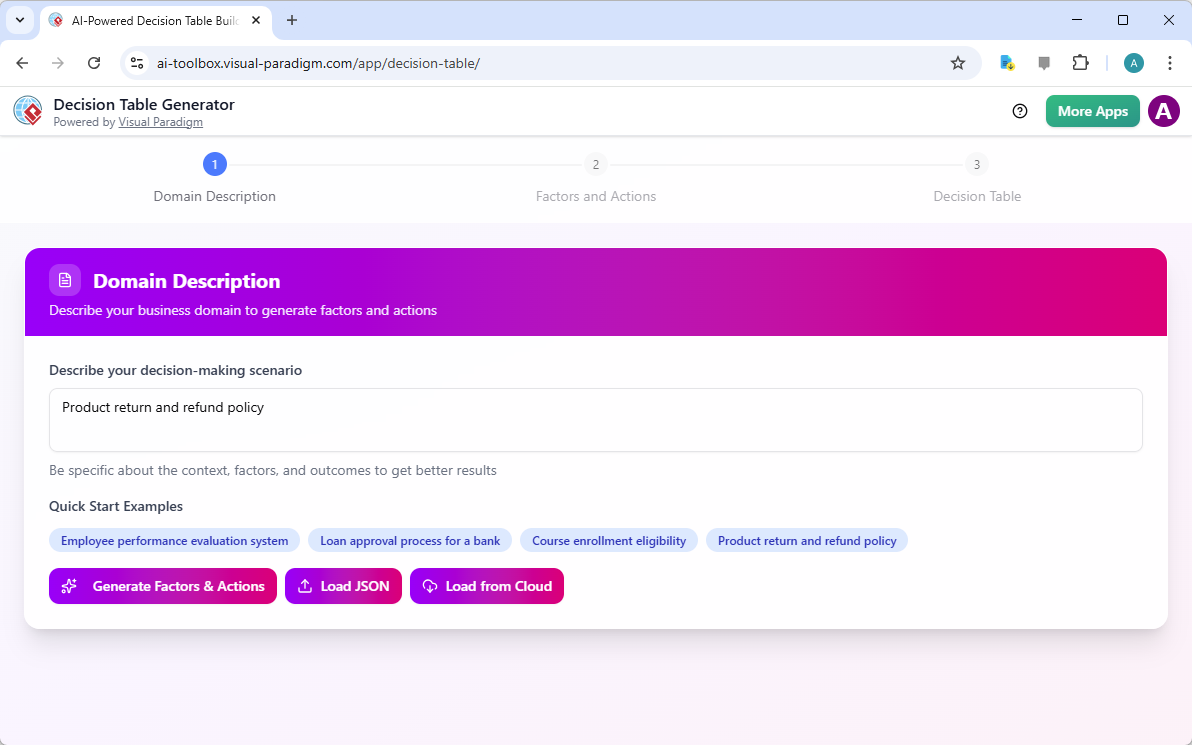
Key Takeaways: Streamlining Business Logic
- AI-Powered Extraction: Automatically identifies decision factors and outcomes from simple text descriptions.
- Structured Visualization: Converts complex scenarios into clear, easy-to-read decision tables.
- Interactive Simulation: Allows users to test specific conditions to ensure logic coverage.
- Gap Detection: Instantly identifies missing rules during simulation, ensuring comprehensive policy coverage.
- Cloud Connectivity: Facilitates secure cloud saving and local JSON management for flexible project handling.
Automating Factor and Action Identification
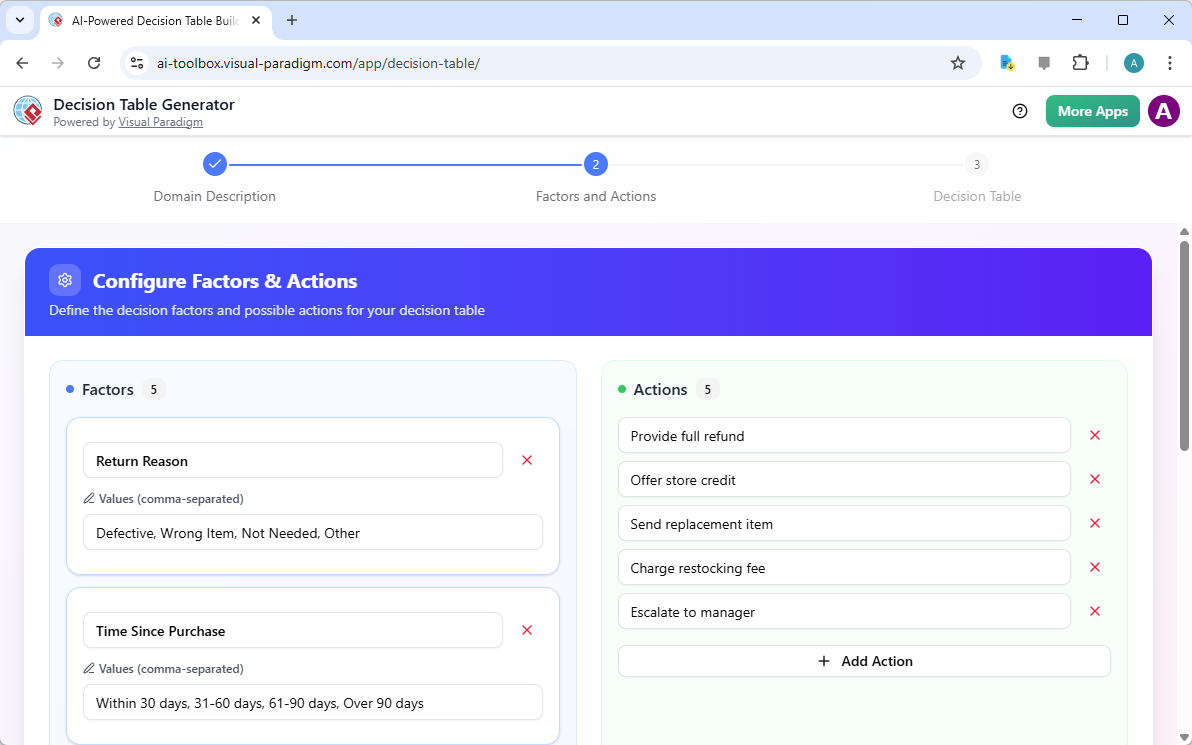
The traditional method of creating decision tables involves a manual, often tedious process of listing every conceivable condition and outcome. Visual Paradigm revolutionizes this workflow through its intelligent domain analysis. Upon entering a scenario description, the Decision Table Generator analyzes the text to extract the fundamental building blocks of the decision logic: the Factors (conditions) and the Actions (outcomes).
As illustrated in the interface, the tool presents a “Configure Factors & Actions” screen where the AI’s suggestions can be reviewed and refined. For a refund policy, the system intelligently identifies factors such as “Return Reason” (with values like Defective, Wrong Item, or Not Needed) and “Time Since Purchase” (e.g., Within 30 days). Simultaneously, it suggests appropriate actions like “Provide full refund” or “Offer store credit.” This interactive editor grants the user full control to modify values, add new variables, or remove irrelevant suggestions, ensuring the logic model perfectly aligns with organizational standards.
Visualizing Complex Rules in a Structured Grid
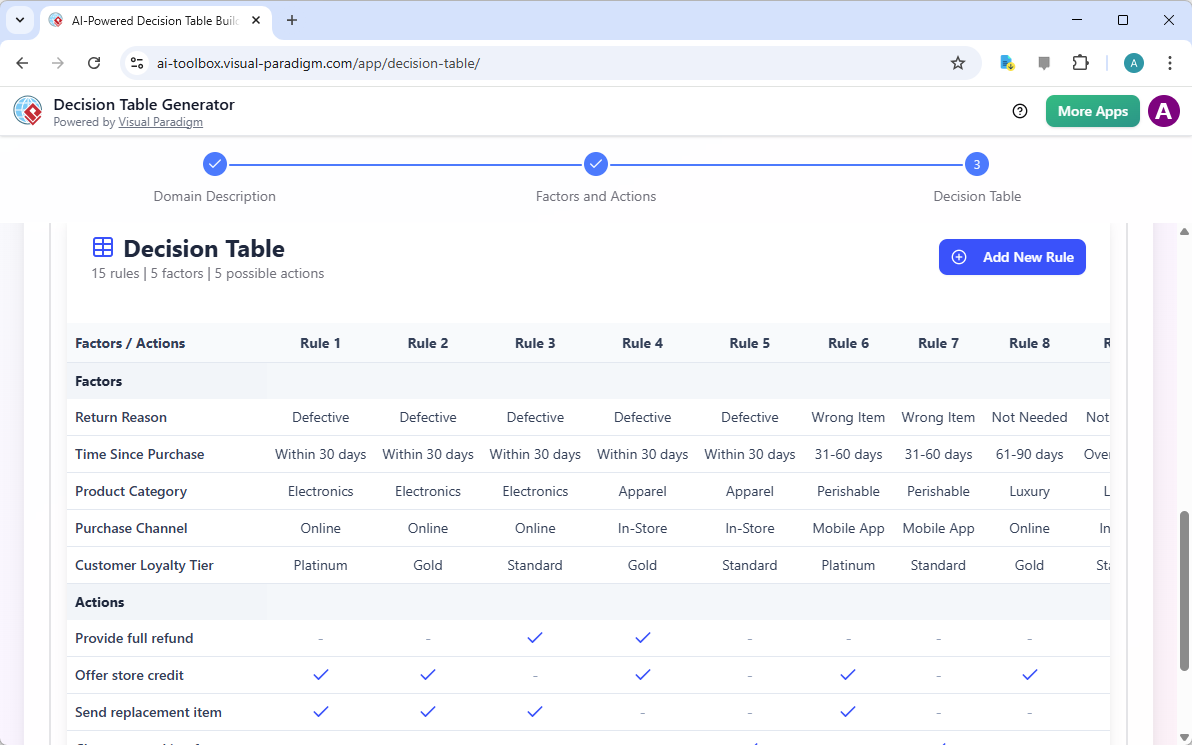
Once the factors and actions are defined, the application generates a comprehensive decision table. This grid format serves as the central repository for the business logic, displaying every rule as a distinct column. This visualization is particularly powerful for complex scenarios where multiple conditions intersect. For instance, a rule might stipulate that if a “Return Reason” is “Defective” and the “Time Since Purchase” is “Within 30 days,” the specific action “Provide full refund” must be triggered.
The generated table provides a high-level overview that makes it easy to spot inconsistencies or redundancies. By mapping factors like “Customer Loyalty Tier” against “Purchase Channel,” stakeholders can verify that high-value customers are receiving the appropriate service levels across all touchpoints. This level of clarity is invaluable for bridging the gap between business requirements and technical implementation, serving as a single source of truth for developers and policy managers alike.
Validating Logic through Scenario Simulation
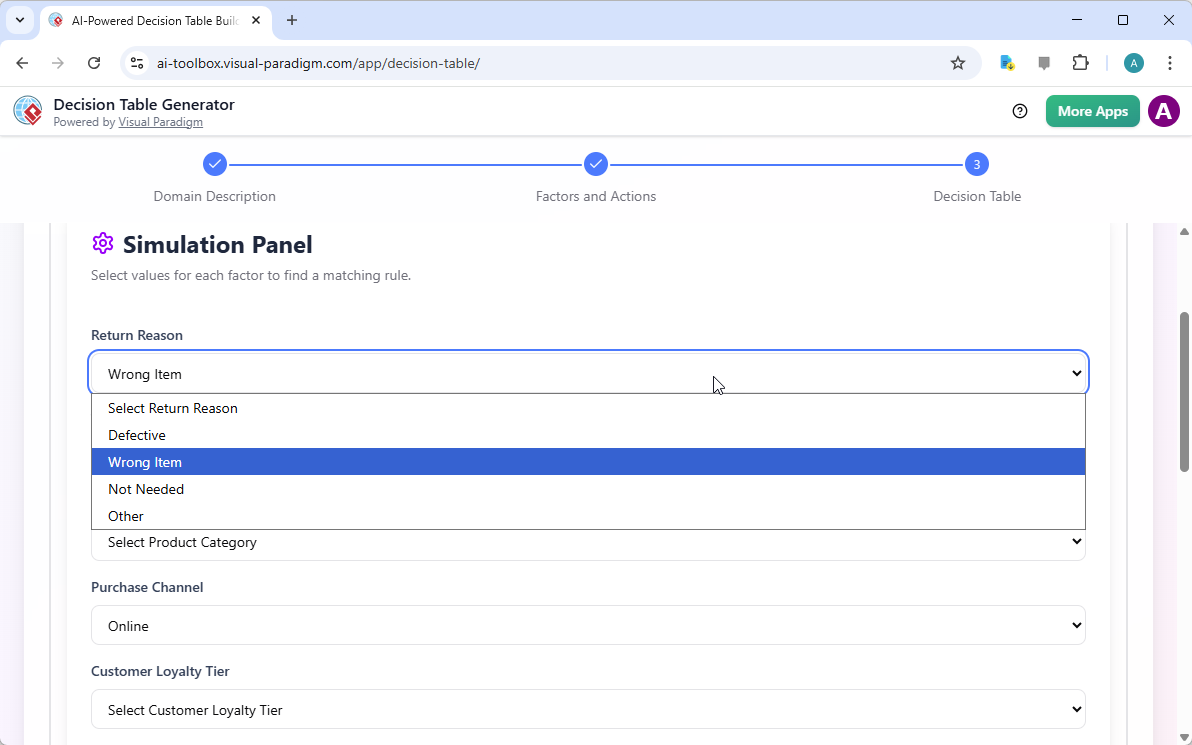
Constructing a decision table is only the first step; validating its accuracy is equally crucial. The Decision Table Generator includes a robust Simulation Panel designed to test the logic against real-world scenarios. This feature allows users to manually select specific values for each factor to query the system, effectively asking, “What happens under these specific conditions?”
In the simulation interface, a user can model a specific case—for example, a customer returning a “Wrong Item” purchased “Online.” By selecting these parameters from the dropdown menus, the user prepares the system to search the existing rule set for a match. This proactive testing phase helps ensure that the defined logic behaves exactly as intended before the rules are deployed into a live business environment.
Ensuring Comprehensive Coverage with Gap Analysis
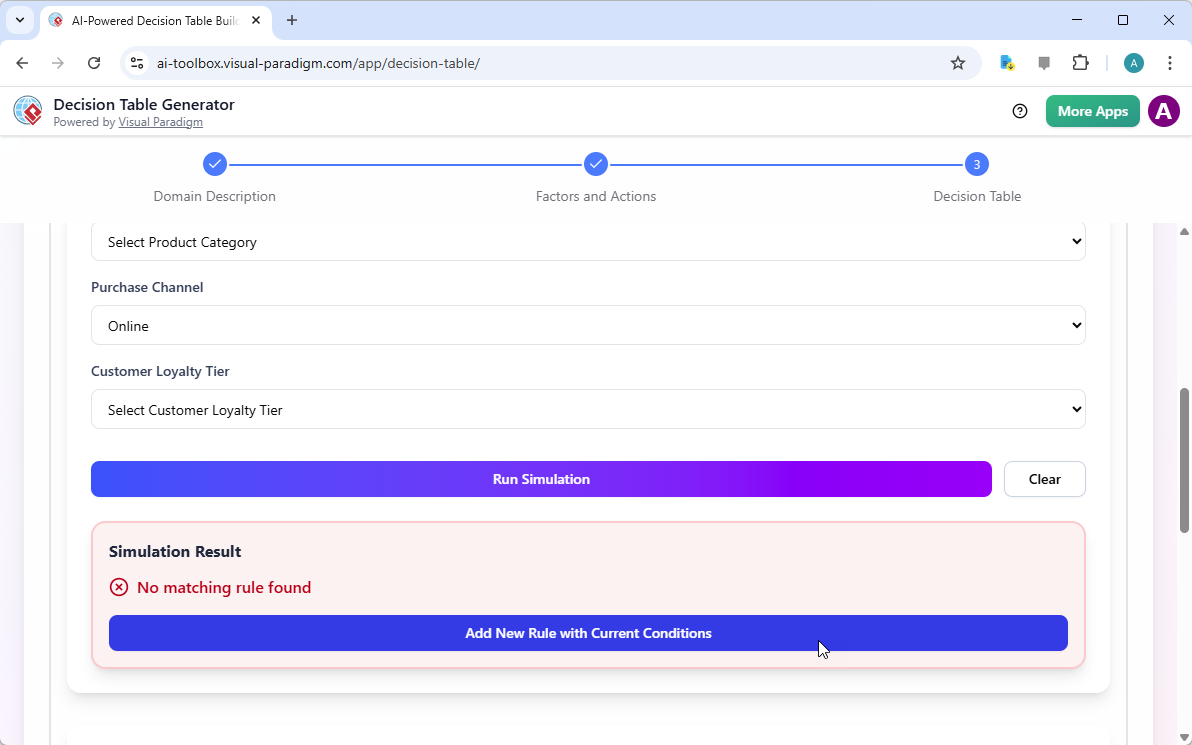
One of the most significant risks in defining business rules is the potential for “logic gaps”—scenarios that have not been accounted for. The simulation tool addresses this by providing immediate feedback. If the selected combination of conditions does not match an existing rule in the table, the system alerts the user with a “No matching rule found” notification.
This feedback loop is instrumental in achieving 100% logic coverage. Rather than leaving the scenario undefined, the tool offers a direct pathway to resolution via the “Add New Rule with Current Conditions” button. This allows the analyst to instantly create a new rule for the unaddressed scenario, filling the gap and strengthening the overall policy. This iterative process of simulation and refinement ensures that the final decision table is robust, comprehensive, and ready for implementation.
Conclusion
Visual Paradigm’s AI-powered Decision Table Generator transforms the daunting task of managing complex business rules into a structured, manageable, and accurate process. By automating the extraction of factors and actions, providing a clear visual grid for rule management, and offering simulation tools to detect logic gaps, it empowers professionals to define policies with confidence. Whether managing product refunds, loan approvals, or system access rights, this tool ensures that decision logic is precise, transparent, and easily communicable across teams.
To experience how this intelligent solution can streamline your business analysis and rule definition processes, visit the link below.
Try the Decision Table Generator Now
Related Links
- AI-Powered Decision Table Generator: A tool that enables users to generate decision tables using artificial intelligence to automate complex business rule modeling.
- What Is an AI-Powered Decision Table? Untangling Complex Business Rules with AI: An informative guide explaining how AI-powered decision tables simplify the modeling and management of complex business logic.
- AI Decision Table Feature: A feature within Visual Paradigm that leverages artificial intelligence to assist in creating and managing decision tables for business rule automation.
- Decision Table Generator App (AI Toolbox): An AI-powered application for generating decision tables with intelligent assistance to streamline rule-based system design.
- Release Notes: AI Decision Table Tool: Release update detailing new capabilities of the AI-driven decision table tool, including enhanced rule generation and integration features.