




How to Use AI Chatbot to Generate and Refine Use Case Diagrams Efficiently
Creating clear, accurate use case diagrams is a foundational step in system analysis and software design. Traditionally, this process involves extensive manual effort—identifying actors, defining use cases, mapping relationships, and documenting flows. With the rise of AI-powered modeling tools, this workflow has evolved dramatically.
Visual Paradigm’s AI Chatbot offers a streamlined, intuitive approach to use case diagramming, transforming high-level business requirements into structured visual models with minimal input. Whether you’re a beginner learning UML or a professional refining system specifications, this AI-powered assistant supports every phase of the process.
🌐 1. Natural Language-to-Model Generation
The core strength of the AI Chatbot lies in its ability to convert plain English into a fully structured use case diagram.
What It Does:
-
Extracts Entities: Automatically detects actors (e.g., Customer, Technician) and use cases (e.g., Withdraw Cash, Check Balance).
-
Maps Relationships: Identifies and establishes connections such as associations, includes, and extends.
-
Creates System Boundary: Defines the system’s scope by placing use cases within a boundary and actors outside.
Example Prompt:
“Generate a use case diagram for an ATM system where a Customer can check balance, withdraw cash, and change PIN, while a Technician can maintain the machine and load cash.”
The AI Chatbot instantly produces a clean diagram with:
-
Correct placement of actors and use cases
-
Logical associations between users and functions
-
A visible system boundary separating internal and external elements
This eliminates the need to manually drag shapes or define relationships from scratch, allowing you to focus on the logic rather than the mechanics of diagramming.
💬 2. Conversational Refinement and Logic Extension
Once the initial diagram is generated, the AI Chatbot enables dynamic adjustments—no need to re-draw or reconfigure.
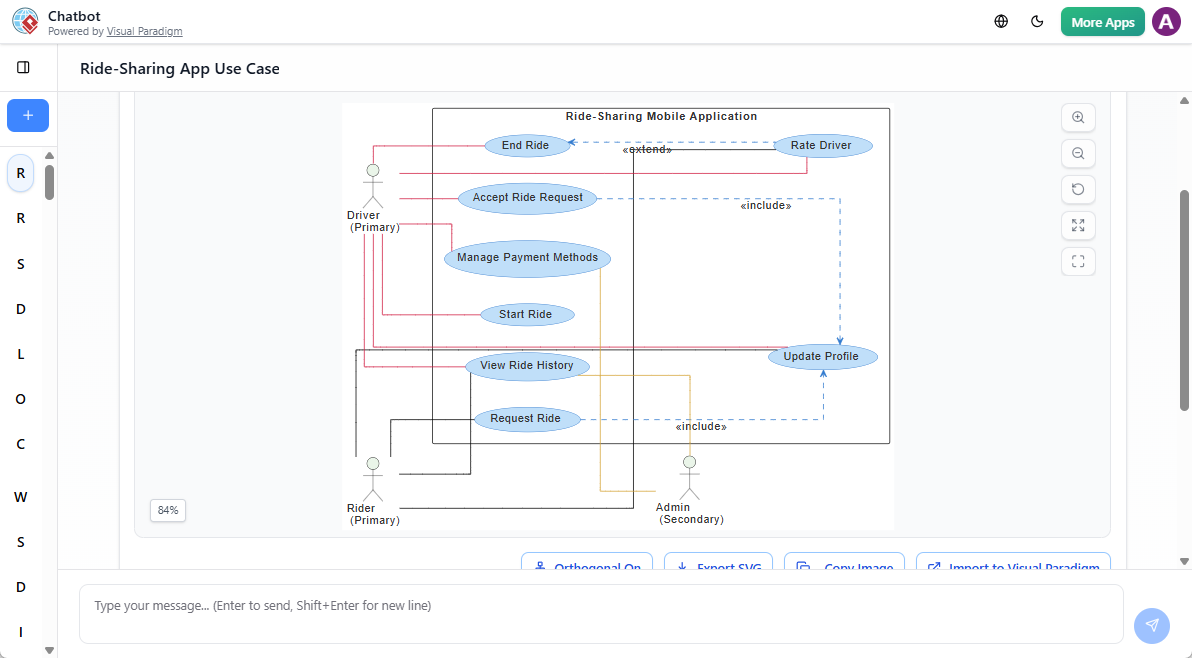
Key Capabilities:
-
Add Relationships: Use natural language to define dependencies.
Example: “Add an ‘Include’ relationship from ‘Withdraw Cash’ to ‘Validate PIN’.” -
Adjust Scope: Simplify or expand the model based on context.
Example: “Remove maintenance-related use cases and focus only on banking transactions.” -
Refine Structure: Modify relationships or group use cases without leaving the chat.
This conversational mode supports iterative design, making it easier to explore different scenarios and validate system behavior early in development.
📄 3. Automated Use Case Descriptions (Documentation)
A diagram alone doesn’t capture the full story. The AI Chatbot generates detailed, standardized descriptions for each use case, aligning with industry best practices.
What It Produces:
-
Basic Flow: Step-by-step sequence of successful execution.
-
Alternative Flows: Branches for common variations (e.g., insufficient funds).
-
Exception Flows: Handling of errors or edge cases (e.g., invalid PIN).
These are delivered in professional formats—bulleted lists or tables—ready for inclusion in requirement documents or user stories.
✅ No more writing flow-of-events from scratch. The AI Chatbot ensures consistency and completeness.
🔄 4. Seamless Transition to Full Modeling Tools
The AI-generated diagram isn’t a standalone output—it’s fully integrated into the Visual Paradigm ecosystem.
Next Steps:
-
Open in Editor: Click to open the diagram in the full Visual Paradigm Online or Desktop editor.
-
Customize Styling: Adjust colors, fonts, layout, and add notes.
-
Export or Share: Generate PNG, PDF, or integrate into documentation.
This ensures the diagram remains editable and reusable across teams, projects, and documentation workflows.
🧠 Why This Matters for Learners and Practitioners
Using the AI Chatbot as an AI UML tool reduces the cognitive load of learning UML. Instead of memorizing syntax or struggling with layout, learners can:
-
Focus on understanding system behavior
-
Experiment with requirements without fear of “doing it wrong”
-
Receive immediate visual feedback on their inputs
This accelerates the learning curve and supports deeper comprehension of use case modeling principles.
🔍 For those new to UML, the AI Chatbot provides a low-friction entry point—turning abstract concepts into tangible visuals.
✅ Best Practices When Using the AI Use Case Diagram Generator
-
Be Specific in Prompts: Include clear roles, actions, and constraints.
-
Iterate with Conversation: Use follow-up commands to refine logic.
-
Validate AI Output: Review generated relationships and flows for accuracy.
-
Use in Conjunction with Documentation: Pair diagrams with AI-generated descriptions for completeness.
🛠️ Use Cases Across Industries
The AI Chatbot is valuable in:
-
Software Development: Define system features before coding.
-
Business Analysis: Translate stakeholder needs into technical requirements.
-
Academic Projects: Support student learning and thesis modeling.
-
Agile Teams: Create and update use cases rapidly during sprints.
📚 References & Their Descriptions
- How AI Chatbot Can Help You Learn UML Faster
This article explains how the AI Chatbot creates an interactive learning environment for UML, offering real-time visualization and feedback to help beginners grasp modeling concepts quickly and effectively. - AI-Powered Use Case Diagram Analyzer
A detailed overview of how Visual Paradigm’s AI automatically generates use case diagrams from natural language, with support for refining models and integrating with existing workflows. - AI Use Case Diagram Generator: A Definitive Guide
A step-by-step guide that walks users through generating and refining use case diagrams using the AI Chatbot, emphasizing efficiency and accuracy in requirement gathering. - AI-Powered UCDD Assistant Guide
A comprehensive reference on using AI to generate problem statements and use case descriptions, helping teams align business needs with technical design. - Use Case Modeling: A Comprehensive Guide
A foundational resource covering the principles of use case modeling, including actor roles, system boundaries, and relationship types, ideal for both new and experienced users. - AI Deployment Diagram Example: Food Delivery Platform
Demonstrates how the AI Chatbot supports not only use case diagrams but also deployment, activity, and other UML diagrams, showcasing its versatility across modeling tasks. - System Boundary in Use Case Diagrams
Explains the role of the system boundary in defining what’s inside and outside a system, helping users correctly position actors and use cases in their diagrams.