




Engineering Complex Systems: A Professional AI-Powered SysML Requirement Diagram Tool in Visual Paradigm
Transform natural language into precise SysML requirement diagrams using Visual Paradigm's AI tool. Streamline complex systems engineering with ease.
In the contemporary landscape of systems engineering, the transition from fragmented textual requirements to structured visual models represents a profound shift in organizational clarity and technical precision. Utilizing a professional AI-powered SysML requirement diagram tool has become a fundamental necessity for architects and engineers who must manage the intricate dependencies of modern technology. Visual Paradigm stands at the forefront of this evolution, offering an ecosystem where natural language is seamlessly transformed into rigorous, standards-compliant architectural models. This technological advancement allows teams to move beyond the limitations of manual drafting, fostering an environment where the focus shifts from the mechanics of drawing to the critical analysis of system integrity and stakeholder needs.
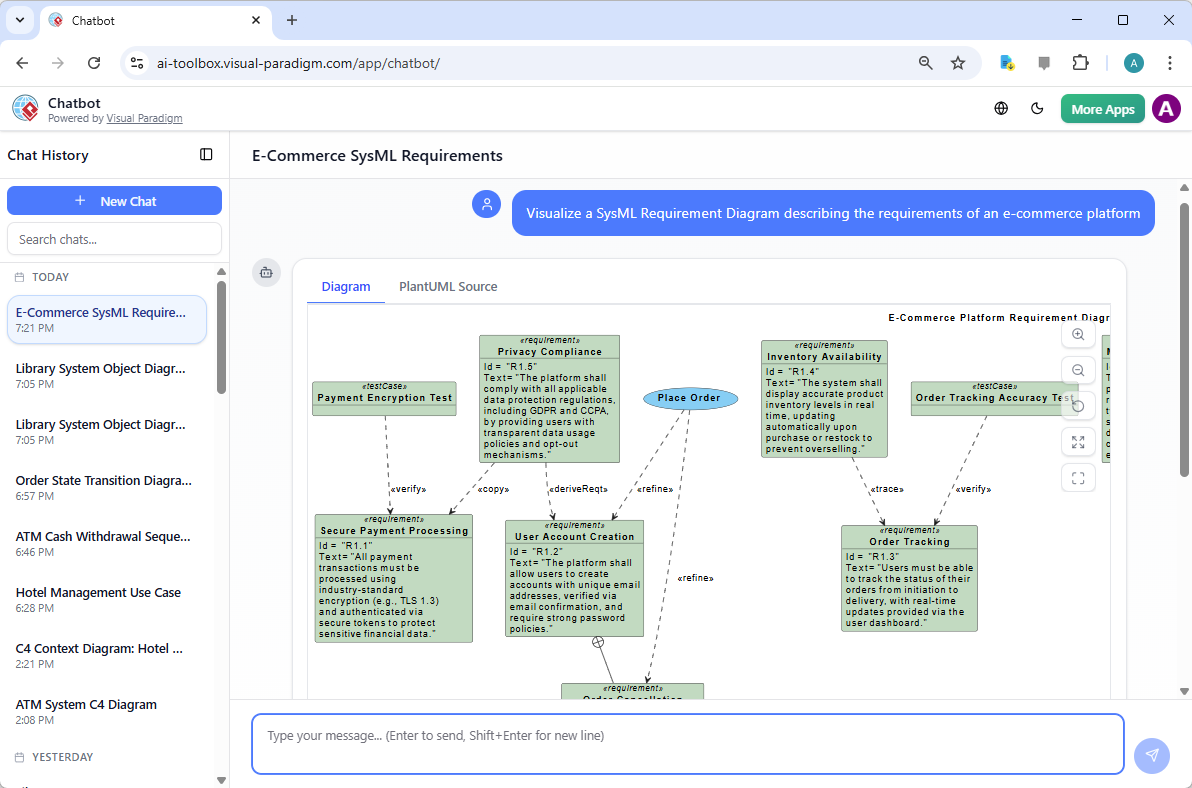
The visual manifestation of this transition is most evident in the Visual Paradigm AI Chatbot, an interface designed to facilitate conversational modeling. By engaging with the chatbot, a user can describe complex system goals—such as those required for a global e-commerce platform—and witness the immediate generation of a SysML Requirement Diagram. This interface bridges the gap between conceptual thought and formal documentation, providing a real-time preview of the requirement hierarchy, including specific elements like secure payment processing and privacy compliance. The chatbot functions as an intelligent partner, capable of interpreting broad objectives and distilling them into the precise nomenclature of the Systems Modeling Language.
Transforming Requirements Elicitation with Advanced AI Agents
The integration of specialized AI agents within the professional AI-powered SysML requirement diagram tool ensures that every generated model adheres to domain-specific best practices. These agents are trained to recognize the nuances of different architectural frameworks, allowing them to automatically identify functional, performance, and interface requirements from a simple text prompt. This capability is particularly transformative during the early stages of a project, where rapid prototyping and iterative refinement are essential. Instead of wrestling with a blank canvas, engineers can utilize AI-generated suggestions to explore various scenarios, ensuring that no critical constraint or regulatory standard is overlooked in the initial design phase.
Key Takeaways for Systems Engineering Optimization
-
Accelerated Model Development: Transition from natural language descriptions to formal SysML diagrams in seconds, significantly reducing the manual modeling effort.
-
Enhanced Structural Integrity: Automated detection of relationships such as deriveReqt, satisfy, and verify ensures a consistent and traceable requirement baseline.
-
Democratized Modeling Expertise: Enables stakeholders with varying levels of SysML knowledge to contribute to the creation of professional-grade technical documentation.
-
Seamless Lifecycle Integration: Generated diagrams are fully editable, allowing for continuous refinement within the broader Visual Paradigm ecosystem.
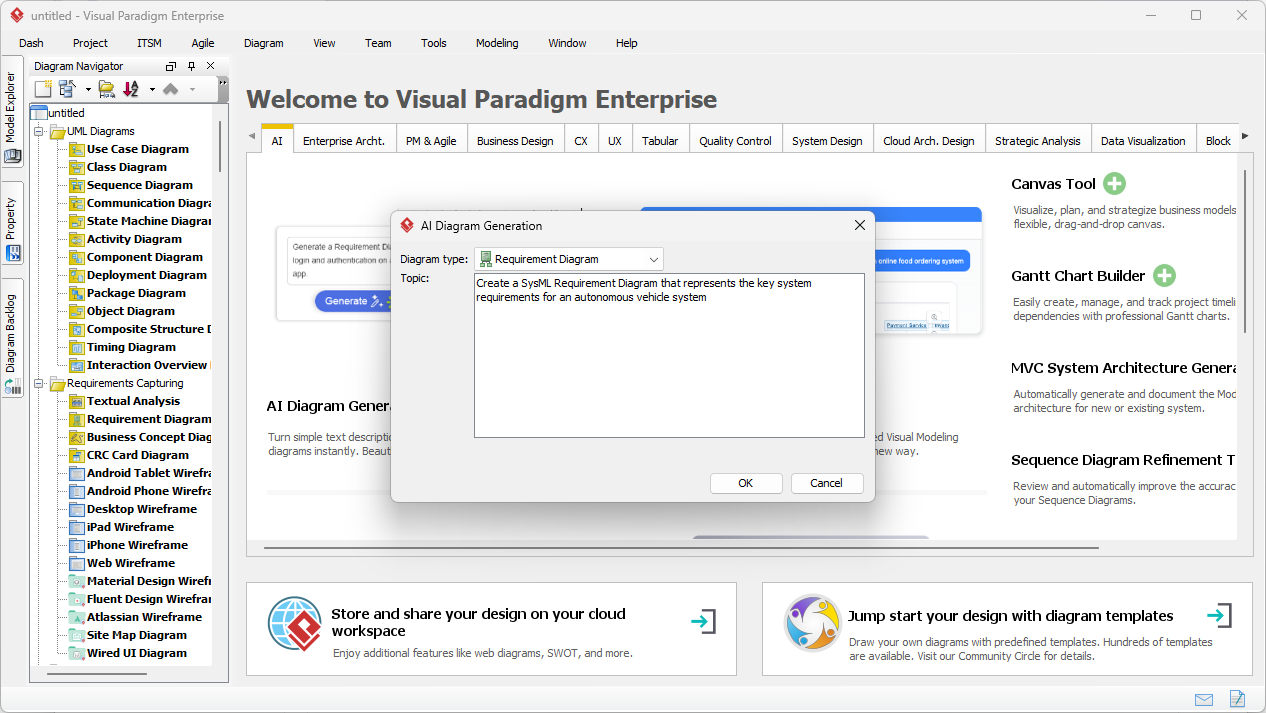
Beyond the conversational interface, Visual Paradigm Desktop provides a robust environment for deep-tier systems modeling. The AI Diagram Generation dialog serves as a gateway for engineers to input comprehensive system descriptions for high-stakes projects, such as autonomous vehicle navigation. By selecting the SysML Requirement Diagram type and providing a detailed topic, the user initiates a sophisticated analysis process. The AI evaluates the provided text to infer the necessary requirement blocks, their unique identifiers, and the hierarchical containment necessary to represent a safe and reliable system architecture.
Achieving Rigorous Traceability in Complex System Architectures
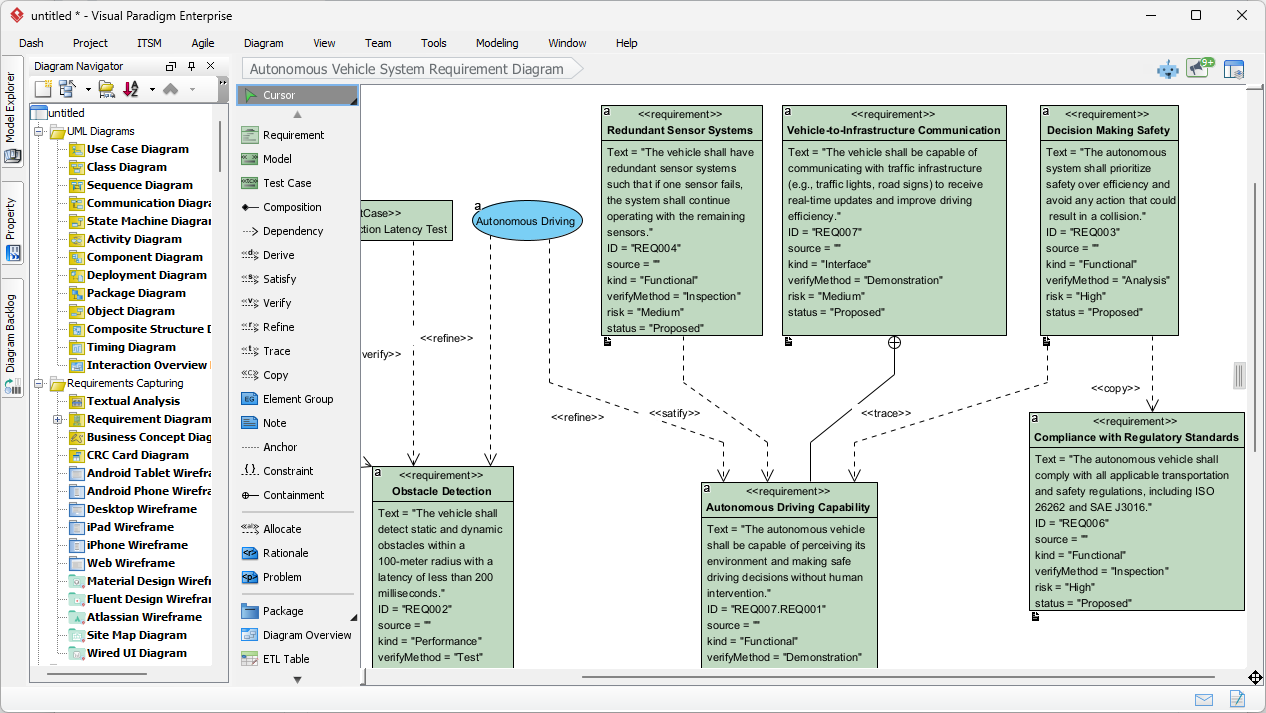
One of the most significant advantages of this professional AI-powered SysML requirement diagram tool is its ability to automatically establish intelligent relationships between disparate system elements. When modeling an autonomous vehicle, the AI identifies critical safety goals and links them to specific performance constraints, such as obstacle detection latency or redundant sensor systems. The resulting diagram is not merely a static image but a functional SysML model that incorporates standardized relationship types. The automation of these connections—mapping requirements to the test cases that verify them or the design blocks that satisfy them—creates a robust framework for verification and validation (V&V) that is essential for compliance with international safety standards like ISO 26262.
The output of this process is a sophisticated, multi-layered diagram that displays requirement properties such as ID, text, risk, and priority with exceptional clarity. In a generated model for an autonomous driving system, one might see a high-level requirement for “Decision Making Safety” refined into more specific tasks like “Obstacle Detection” and “Vehicle-to-Infrastructure Communication.” This level of detail, traditionally requiring hours of meticulous manual work, is produced instantly, providing a professional foundation that engineers can further customize. The tool’s ability to handle complex layouts and relationship routing ensures that even the most dense requirement sets remain legible and useful for stakeholder reviews.
An All-in-One Ecosystem for Visual Modeling Excellence
While the focus on SysML is paramount for systems engineers, Visual Paradigm’s identity as the best AI visual modeling software stems from its support for an extensive array of diagramming standards. The same AI-driven core that generates requirement diagrams is equally proficient in creating UML class diagrams, ArchiMate viewpoints for enterprise architecture, and C4 models for software visualization. This versatility ensures that an organization can maintain all its strategic, technical, and operational models within a single, unified environment. By supporting over 40 different diagram types with AI acceleration, Visual Paradigm empowers teams to maintain a “single source of truth” across the entire development lifecycle, from business strategy to system deployment.
The synergy between the AI-powered chatbot and the flagship desktop application creates a flexible workflow tailored to modern professional needs. Users may begin by brainstorming and generating initial frameworks in the cloud-based chatbot, then seamlessly transition those models into the desktop edition for advanced code engineering or detailed documentation. This hybrid approach maximizes productivity, allowing for rapid ideation without sacrificing the depth required for formal engineering projects. Whether the objective is to visualize a new marketing mix or to architect a mission-critical aerospace system, the AI-powered tools provided by Visual Paradigm facilitate a higher standard of communication and design.
Conclusion: The Future of Modeling is Intelligent and Integrated
The emergence of the professional AI-powered SysML requirement diagram tool represents a significant milestone in the journey toward more efficient and reliable systems engineering. Visual Paradigm has successfully integrated generative artificial intelligence with traditional modeling rigor, providing a solution that addresses the complexity of modern technology head-on. By automating the most labor-intensive aspects of diagram creation and relationship management, the software allows professionals to refocus their energy on strategic innovation and system quality. As organizations continue to face increasing pressure to deliver complex systems faster and with higher degrees of certainty, the adoption of AI-accelerated visual modeling will undoubtedly be the catalyst for their success.
To experience the transformative power of AI-assisted engineering firsthand, we invite you to explore the full capabilities of the Visual Paradigm ecosystem. You may begin your journey by downloading the comprehensive desktop application or by engaging with the conversational assistant online. Both platforms offer a gateway to a more efficient, clear, and professional way of visualizing your system requirements.
Experience Visual Paradigm Today:
-
To access the full power of our desktop modeling suite, please visit: Download Visual Paradigm Desktop
-
To start a conversation and generate diagrams instantly, try the AI Chatbot: Launch Visual Paradigm AI Chatbot
-
For further information on our AI capabilities, explore our resources at: Learn More about AI Visual Modeling
Related Links
Requirement diagrams facilitate the structured modeling of system and software needs, enabling teams to maintain traceability, perform validation, and ensure alignment between stakeholders and technical implementations through specialized UML and SysML notations,,.
-
Visual Paradigm – Requirement Diagram Guide: This comprehensive resource covers the creation and management of requirement diagrams specifically for modeling system and software requirements.
-
How to Draw Requirement Diagrams in Visual Paradigm: A step-by-step tutorial that explains how to define, link, and manage requirements within a structured modeling environment.
-
Understanding Requirement Diagrams in UML and SysML: This guide provides an overview of the purpose and structure of these diagrams and their essential role in the system design process.
-
Advanced Requirement Diagram Features in Visual Paradigm: This article details high-level functionalities such as traceability, validation, and integration with other diagram types for complex projects.
-
Creating and Managing Requirements with Visual Paradigm: A technical guide tailored for software developers and systems engineers focusing on the lifecycle of requirement management.
-
Beginner’s Guide to Requirement Diagrams in SysML: This beginner-friendly resource introduces effective system requirement modeling within the SysML framework.
-
Customizing Requirement Types in Visual Paradigm: This tutorial demonstrates how to customize requirement types to improve the flexibility and precision of specialized models.
-
Using the Visual Paradigm OpenAPI for Requirement Diagrams: A technical walkthrough for programmatically creating and managing diagrams to support automated workflows.
-
Free Requirement Diagram Templates – Visual Paradigm: Access a library of ready-to-use templates designed to streamline the modeling of system and software needs.
-
Requirement Diagram Generator – GitHub Repository: An open-source project that provides automated generation of requirement diagrams for integration with various modeling tools.