




How to Benchmark Netflix Against Disney+ and Amazon Prime with AI
Discover how AI-powered benchmarking tools help analyze Netflix, Disney+, and Amazon Prime with structured insights and actionable strategies.
Ever wish you could instantly create a professional-grade benchmarking analysis for your business, complete with clear objectives, key metrics, and an actionable improvement plan? With Visual Paradigm’s AI-Powered Benchmarking Analysis Tool, you can do exactly that—without needing a team of consultants. This powerful online benchmarking tool guides you through a structured 5-step process, and its AI feature can generate a full, detailed analysis in seconds based on a simple description of your business. We’ll walk you through a real-world example using Netflix, one of the world’s most recognized video streaming platforms, to show you exactly how this AI-powered analysis tool works from start to finish.
Quick Summary: Key Takeaways
- Use the AI-Powered Benchmarking Analysis Tool to generate a complete analysis in minutes.
- Follow a structured 5-step wizard: Define Objectives, Identify Metrics, Collect Data, Develop a Plan, and Generate a Report.
- Let AI suggest objectives, metrics, and improvement strategies based on your business context.
- Manually refine AI-generated data with your own research and insights.
- Export a professional report to share with stakeholders or save locally.
Let’s dive into the process, starting with the first step.
Step 1: Define Your Benchmarking Objectives
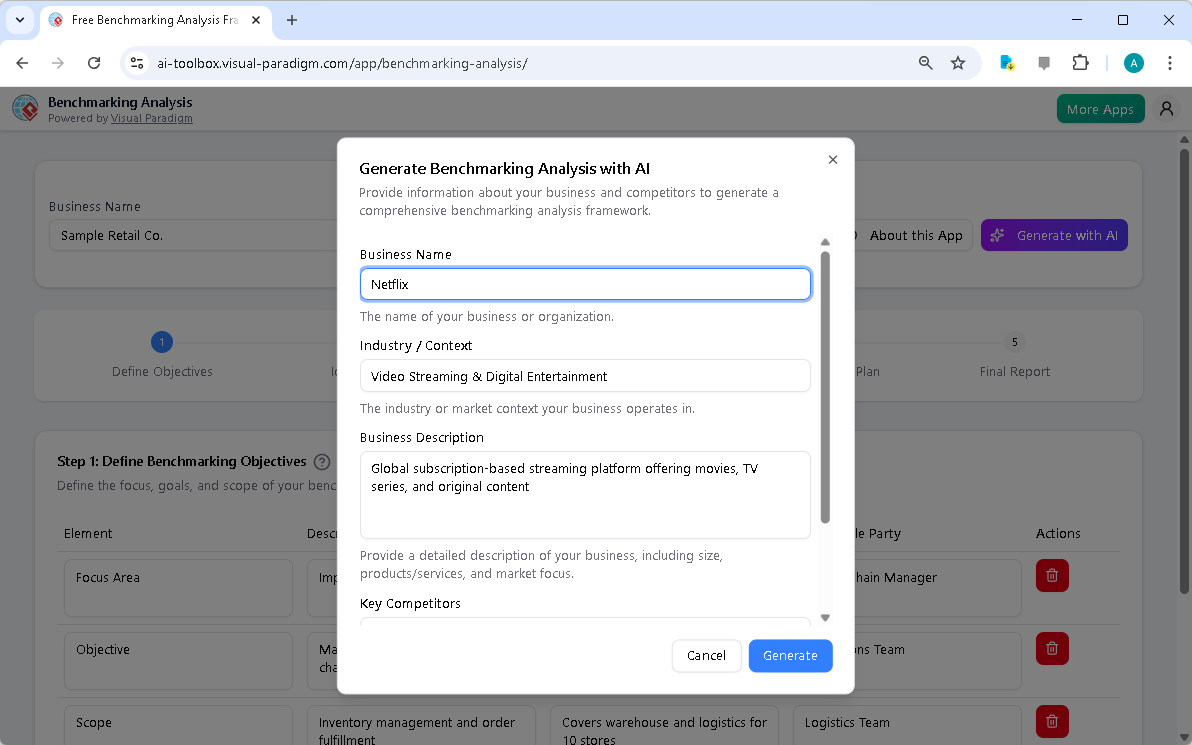
Before you can compare your business to others, you need to know what you’re trying to achieve. The first step in the Visual Paradigm tool is to define your objectives. In our example, we’re using Netflix, a global subscription-based streaming platform, and we want to benchmark it against key competitors like Disney+, Amazon Prime Video, and Hulu. The tool prompts you to enter your business name, industry, and a brief description. Once you’ve done that, you can hit the “Generate with AI” button.
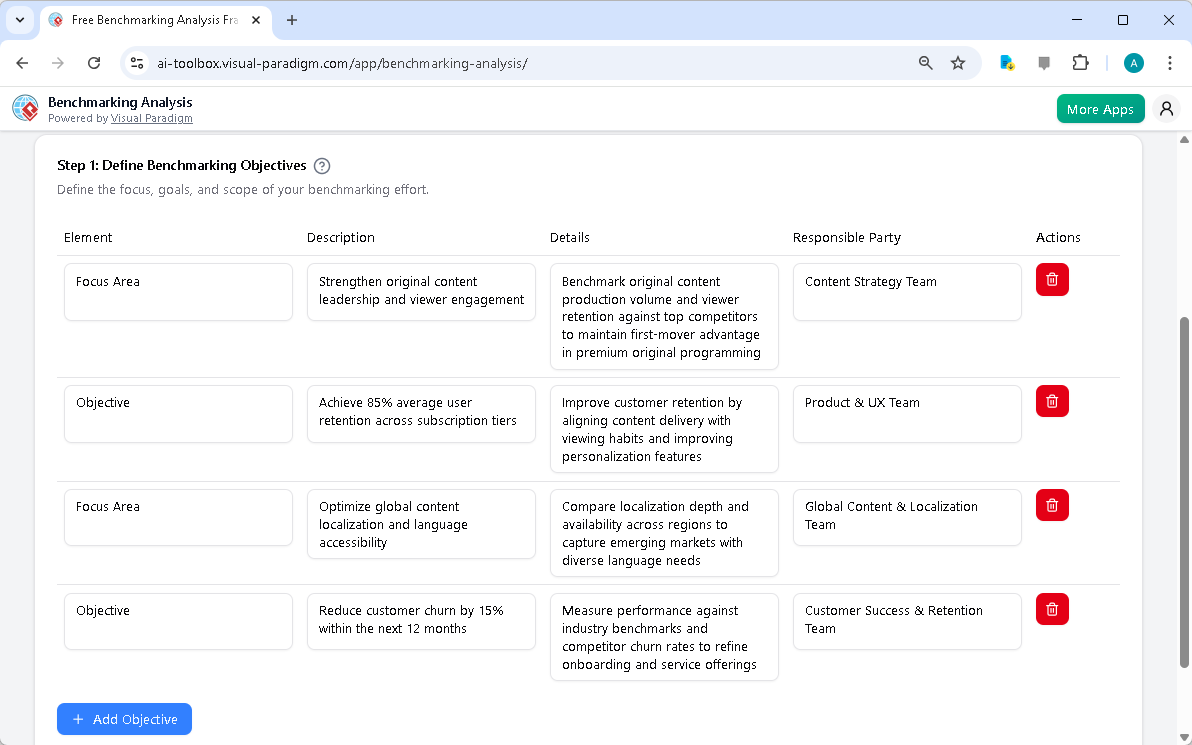
After the AI generates the results, you’re taken to Step 1: Define Benchmarking Objectives. The tool populates a table with suggested objectives based on the information you provided. For Netflix, the AI has identified key focus areas like strengthening original content leadership and improving user retention. Each objective includes a description and a responsible party, which helps assign accountability. This is where you can start to see how the tool turns a vague idea into a structured analysis.
Step 2: Identify Metrics and Comparators
Now that you’ve defined your objectives, it’s time to get specific. Step 2 is all about identifying the key performance metrics you’ll use to measure your success and the competitors you’ll compare against. The AI suggests relevant metrics, such as average viewing duration per user, original content production volume, and customer churn rate. For each metric, it also suggests a comparator—like Disney+ for viewing duration or Amazon Prime Video for content production volume.
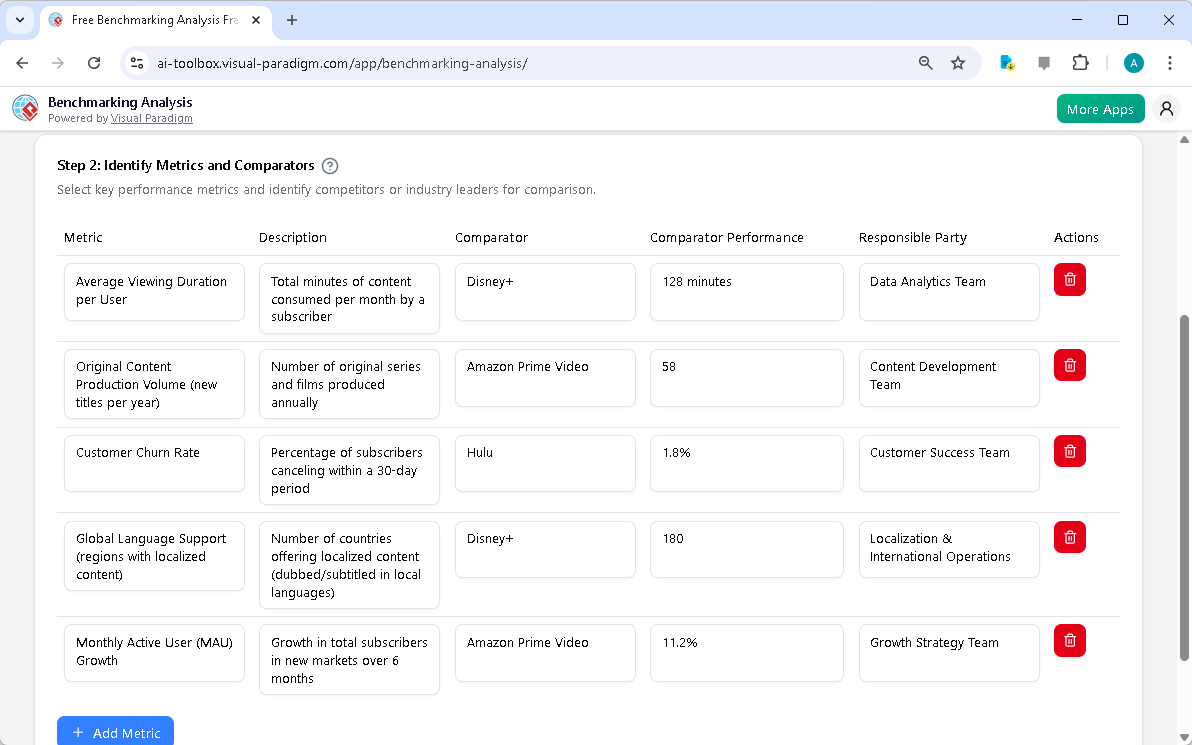
At this stage, you can easily edit the AI’s suggestions. For example, if you know that a specific competitor is a better benchmark for your needs, you can change the “Comparator” column. The tool also allows you to add new metrics and comparators as needed. This flexibility ensures that your analysis is tailored to your unique business context.
Step 3: Collect and Analyze Data
With your metrics and comparators defined, the next step is to collect and analyze your data. In Step 3, the tool provides a table where you can input your current performance and the performance of your competitors. The AI has already filled in some placeholder data, but you’ll need to replace this with your actual research.

For instance, the AI might suggest that Netflix’s average viewing duration is 112 minutes per user, while Disney+ is at 128 minutes. You can then input your actual data and see the performance gap. This step is crucial for identifying where you’re falling short and where you have a competitive advantage. The tool automatically calculates the performance gap, making it easy to spot areas that need improvement.
Step 4: Develop an Improvement Plan
Now that you’ve analyzed your data, it’s time to turn your insights into action. Step 4 is where you develop an improvement plan based on the performance gaps you’ve identified. The AI suggests strategies to close these gaps, such as expanding your original content pipeline or enhancing personalized viewing recommendations.

Each strategy includes a description, an implementation plan, and an expected outcome. For example, to improve viewing duration, the AI might suggest establishing dedicated production units in key regions and prioritizing culturally relevant formats. You can then refine these strategies based on your specific business needs and resources. This step ensures that your analysis leads to concrete, actionable steps.
Step 5: Generate Your Final Report
Finally, Step 5 is where all your hard work comes together. The tool compiles all the information you’ve gathered into a professional, easy-to-read report. The final report includes an executive summary, strategic objectives, and a detailed analysis of your metrics and improvement plans.
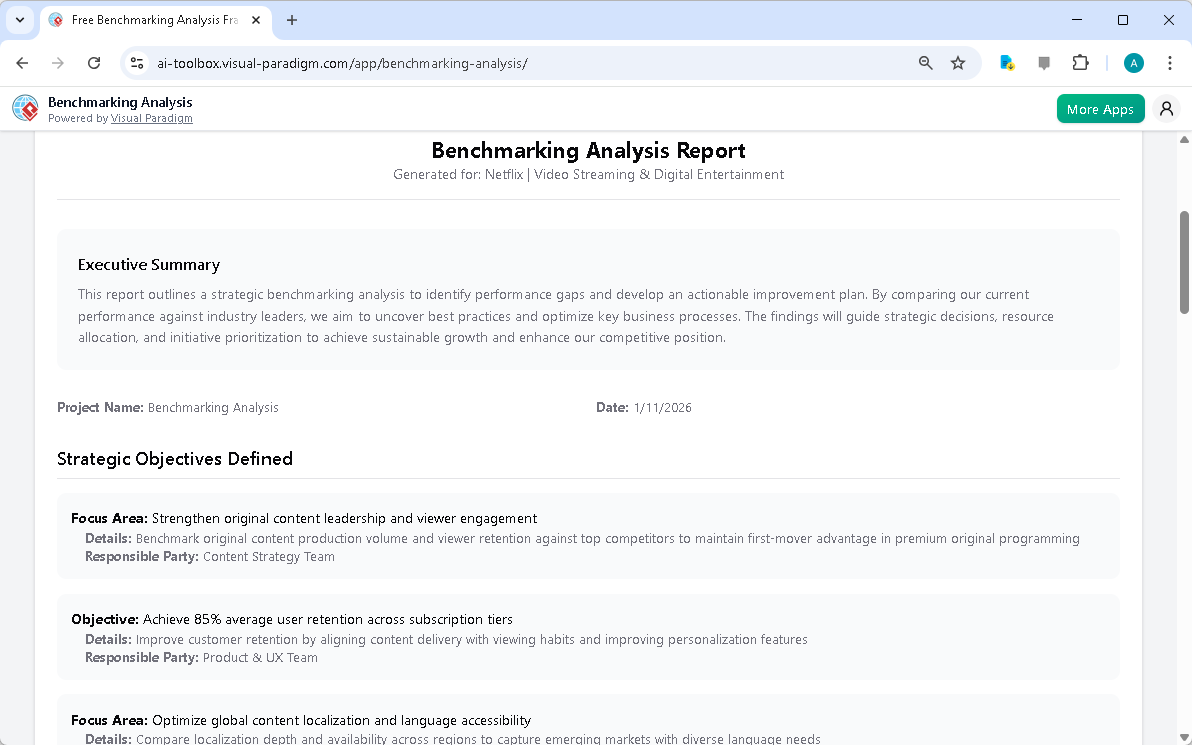
At this point, you can print the report or save it as a PDF. This final document is perfect for sharing with your team, stakeholders, or leadership. It provides a clear overview of your benchmarking study and the strategies you plan to implement. The entire process—from defining objectives to generating a final report—can be completed in minutes, thanks to the AI-powered features of the tool.
Conclusion
Visual Paradigm’s AI-Powered Benchmarking Analysis Tool is a game-changer for businesses looking to improve their performance and gain a competitive edge. By following a structured 5-step process and leveraging AI to generate a comprehensive analysis, you can quickly identify performance gaps and develop actionable improvement plans. Whether you’re a business strategist, operations manager, or product manager, this tool provides the framework and insights you need to make data-driven decisions.
Ready to see how this tool can transform your business? Try the AI-Powered Benchmarking Analysis Tool now and start creating your own professional benchmarking reports in minutes.
Related Links
- Free Benchmarking Analysis Tool for Performance Comparison – Visual Paradigm Product Updates: September 9, 2025 – Measure your performance against competitors with our free benchmarking analysis tool. Identify strengths, weaknesses, and opportunities for improvement with AI-powered insights.
- Visual Paradigm AI Guide: Architecture, Standards, and Benefits: A comprehensive guide to the Visual Paradigm AI Visual Modeling Platform. Explore its ArchiMate architecture, standardized UML support, and how it automates system design compared to generic LLMs.
- Free Benchmarking Analysis Tool | Visual Paradigm Online: Identify performance gaps and discover best practices with free Visual Paradigm’s Benchmarking Tool. Compare against competitors and drive strategic growth. Learn more.
- Visual Paradigm Review: AI-Powered Modeling & Design Tools: Explore our in-depth review of Visual Paradigm . Discover how its new Generative AI engine transforms UML modeling, agile management, and enterprise architecture.
- Free Benchmarking Analysis Framework | Visual Paradigm Online: Start your benchmarking analysis . Define objectives, identify metrics, analyze performance gaps, and create your strategic improvement plan with our free interactive framework.
- Benchmarking Analysis Framework – s.visual-paradigm.com: The Benchmarking Analysis Tool is designed to help organizations systematically compare their performance metrics against competitors or industry standards. It provides a structured framework to identify gaps, analyze root causes, and develop actionable strategies that drive continuous improvement.
- Visual Paradigm AI Platform: A Comprehensive ArchiMate Guide: Explore the Visual Paradigm AI Visual Modeling Platform through the ArchiMate perspective. Learn how its standardized intelligence, persistent visual structures, and context-aware tools outperform generic LLMs.