




Creating a Strategic Plan for EcoMotion Mobility: An AI-Powered SWOT-TOWS Guide
Use an AI-powered SWOT-TOWS tool to create a strategic plan for your business in minutes. Ideal for startups and entrepreneurs.
Ever feel like you’re staring at a blank page when trying to figure out your business’s next move? You know you need a solid strategy, but the process feels overwhelming. Enter the AI-Powered SWOT-TOWS Business Analysis Tool from Visual Paradigm. It’s like having a strategic consultant by your side, guiding you step-by-step through a comprehensive analysis. Let’s take a look at how it works, using the example of a fictional electric vehicle company, EcoMotion Mobility, to see how you can create a professional strategic plan in minutes.
Quick summary
- Use the AI-Powered SWOT-TOWS Business Analysis Tool to generate a strategic plan quickly.
- Start by entering your business name and industry context.
- Let AI generate initial SWOT factors, then refine them with your own insights.
- Use the TOWS Matrix to turn analysis into actionable strategies.
- Generate a professional report to share with your team.
Imagine you’re a business strategist or an entrepreneur who just started a company called EcoMotion Mobility, focused on electric vehicles and sustainable transportation. You need to understand your competitive landscape, but you don’t have time for a lengthy market research project. That’s where this tool shines. It’s designed to be intuitive and efficient, guiding you through a structured 6-step process that turns complex strategic thinking into a simple, visual workflow.
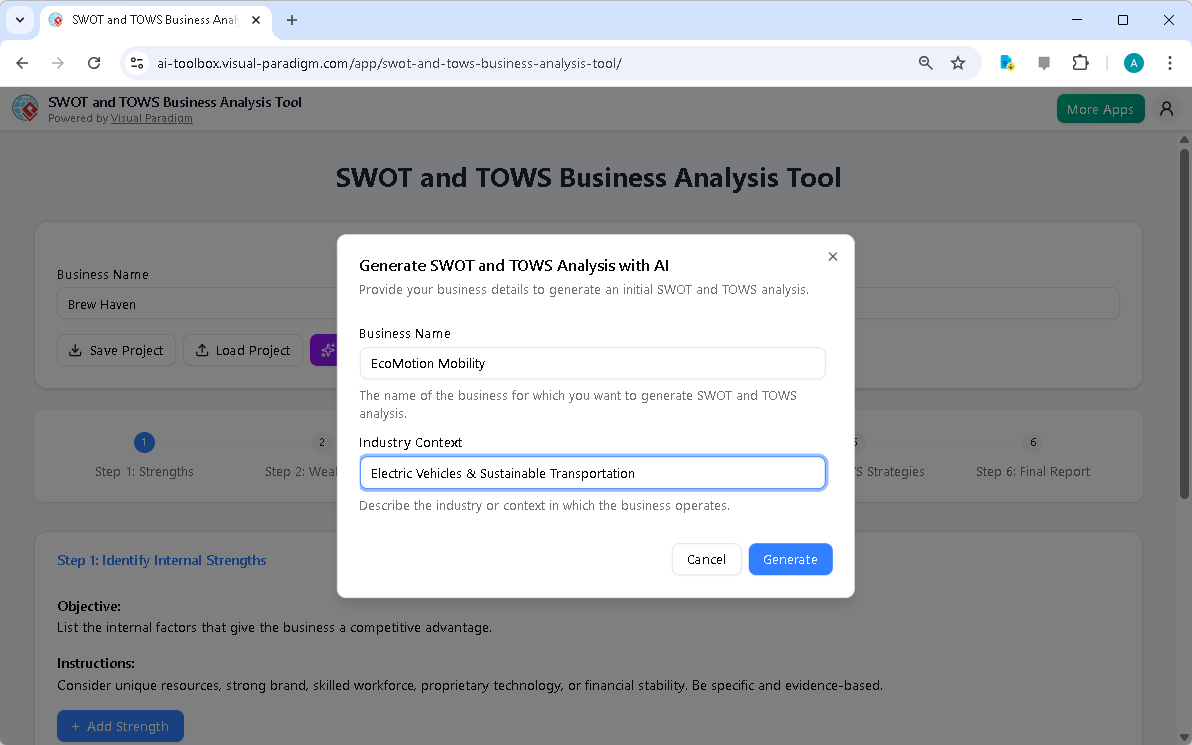
First, you begin by providing your business context. The tool asks for your “Business Name” and “Industry Context.” In our example, you enter “EcoMotion Mobility” and “Electric Vehicles & Sustainable Transportation.” Then, you hit the “Generate with AI” button. This is the magic moment—within seconds, the tool uses its AI to populate your entire SWOT analysis. It doesn’t just spit out generic ideas; it uses your specific business and industry to generate relevant, evidence-based factors. It’s like the AI has done the initial research for you, giving you a strong starting point.
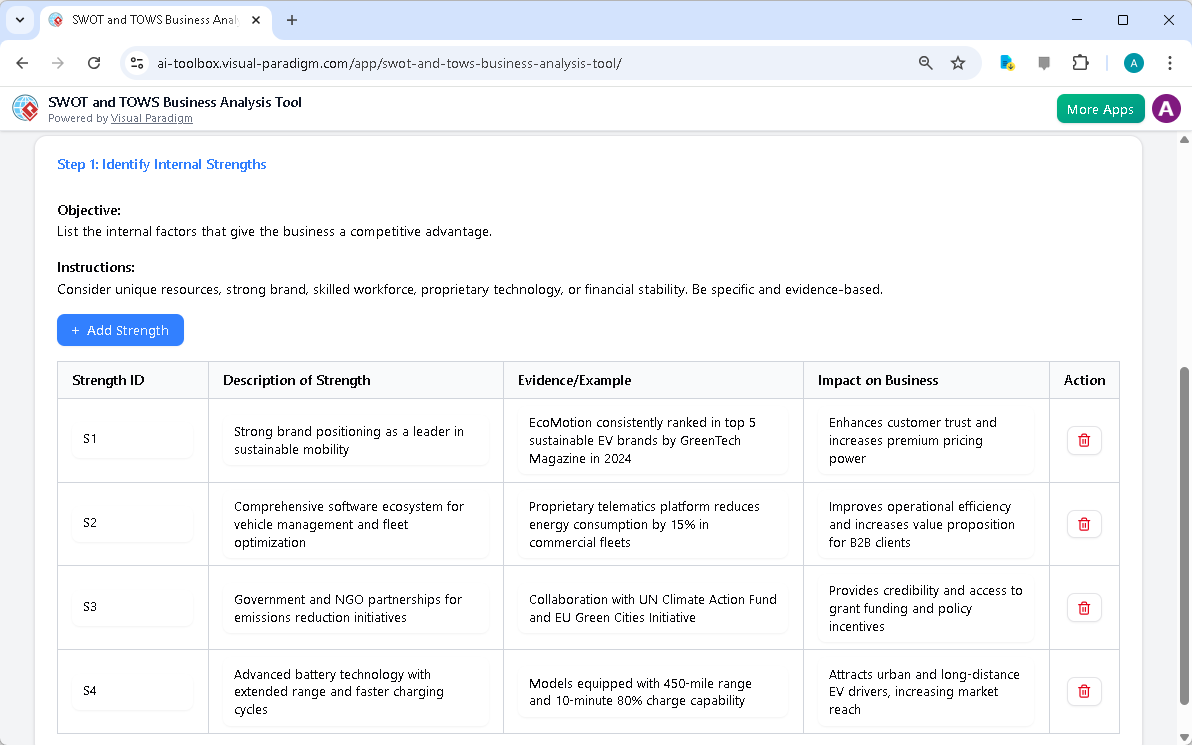
Now you’re in Step 1: Identify Internal Strengths. The tool presents a clean table with columns for “Strength ID,” “Description,” “Evidence/Example,” and “Impact on Business.” You can see that the AI has already populated the table with factors like a “Strong brand positioning” and a “Comprehensive software ecosystem.” You can edit these directly in the table—maybe you want to add a new strength or refine the evidence. This interactive, dynamic table makes it easy to build your analysis. It’s not just a list; it’s a living document where you can add, edit, and delete rows as you think of new ideas.
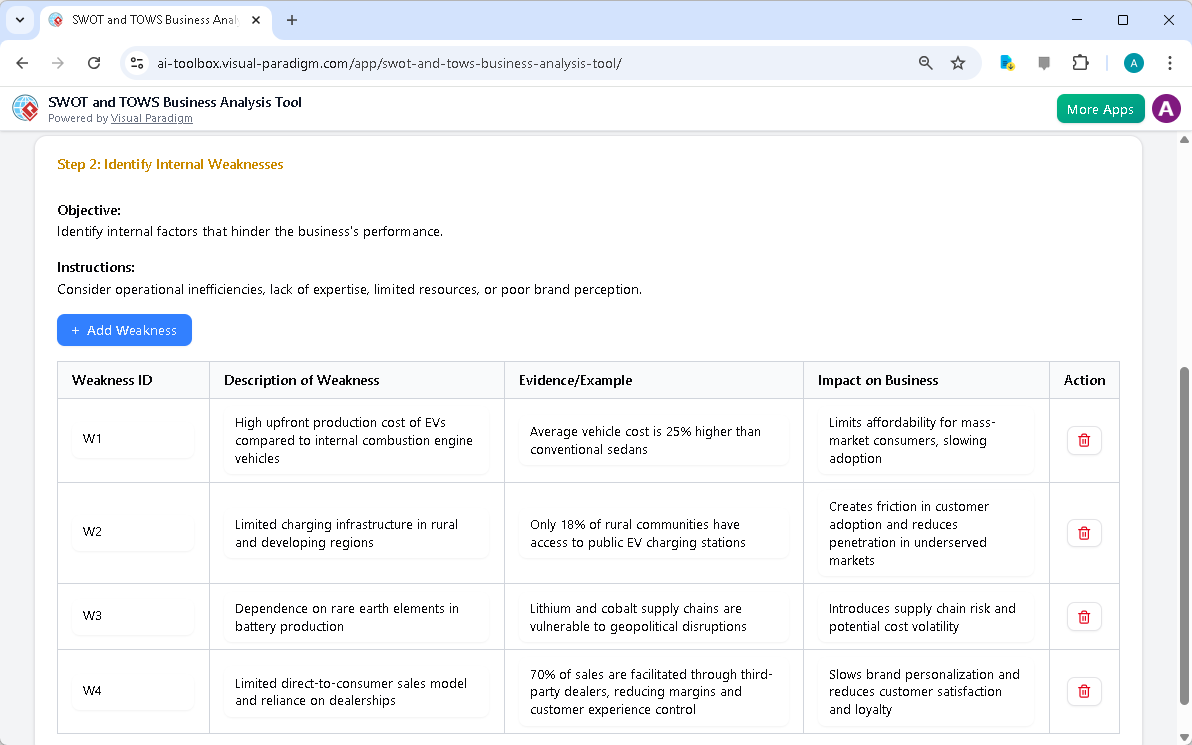
Next, you move to Step 2: Identify Internal Weaknesses. The tool guides you to consider factors that hinder your performance, such as high production costs or limited infrastructure. The AI has already suggested some weaknesses, like the “High upfront production cost of EVs.” You can review these and add your own, like a “Limited direct-to-consumer sales model.” The tool’s structure ensures you don’t miss any key internal factors.
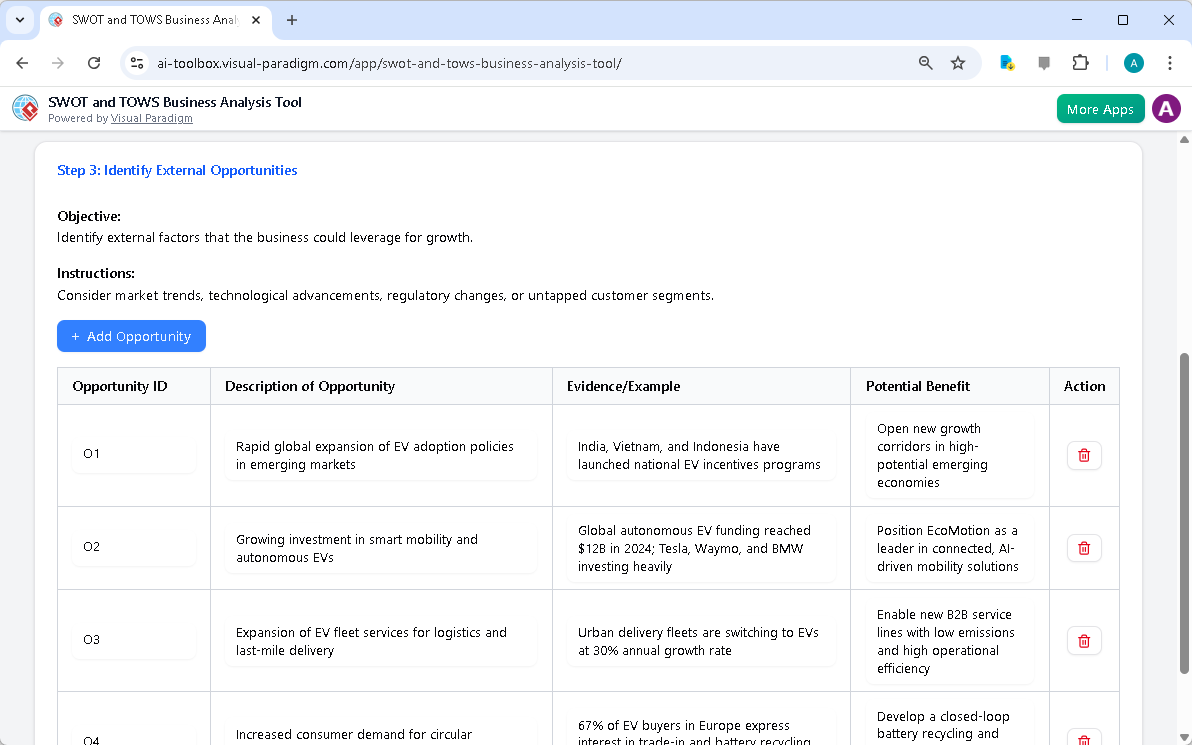
Then it’s time for Step 3: Identify External Opportunities. Here, the focus shifts to the outside world. The AI might suggest “Rapid global expansion of EV adoption policies in emerging markets.” You can add your own insights, like a new government incentive program. The tool helps you see the big picture of what you can leverage.
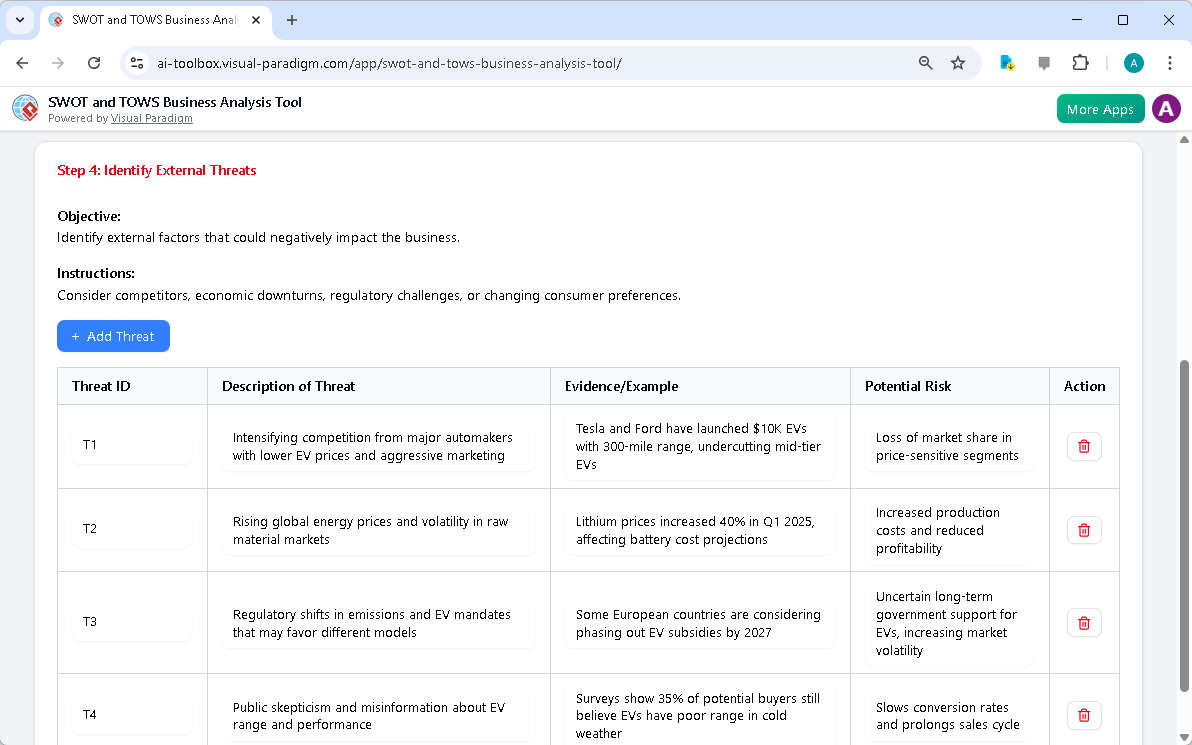
Step 4 is all about External Threats. This is where you identify risks, like “Intensifying competition from major automakers.” The AI helps you spot potential dangers, such as rising energy prices. You can add your own concerns, like public skepticism about EV performance. This step is crucial for building a resilient strategy.
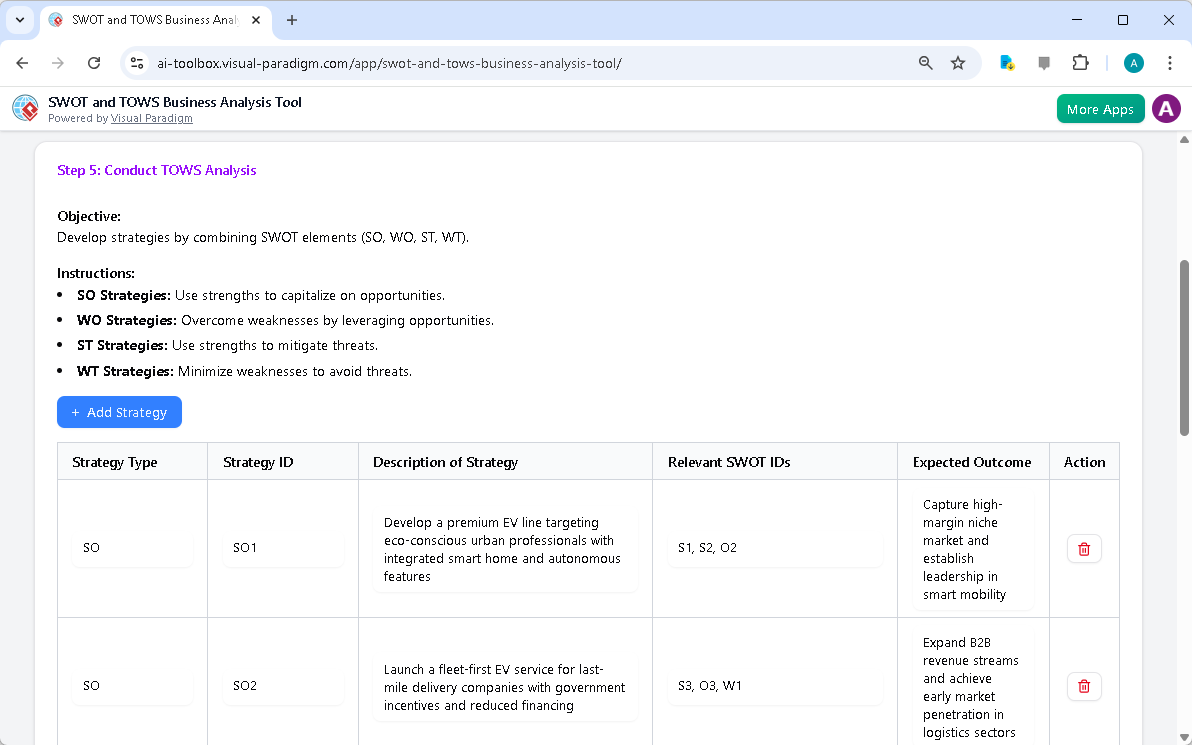
Now comes the exciting part: Step 5, Conduct TOWS Analysis. This is where the magic happens. The tool uses your completed SWOT to generate actionable strategies. For example, it might suggest an “SO Strategy” to capitalize on a strength (like your strong brand) to seize an opportunity (like the growing investment in smart mobility). You can see how the tool combines your internal strengths and external opportunities to create concrete plans. You can also add your own strategies if you have different ideas.
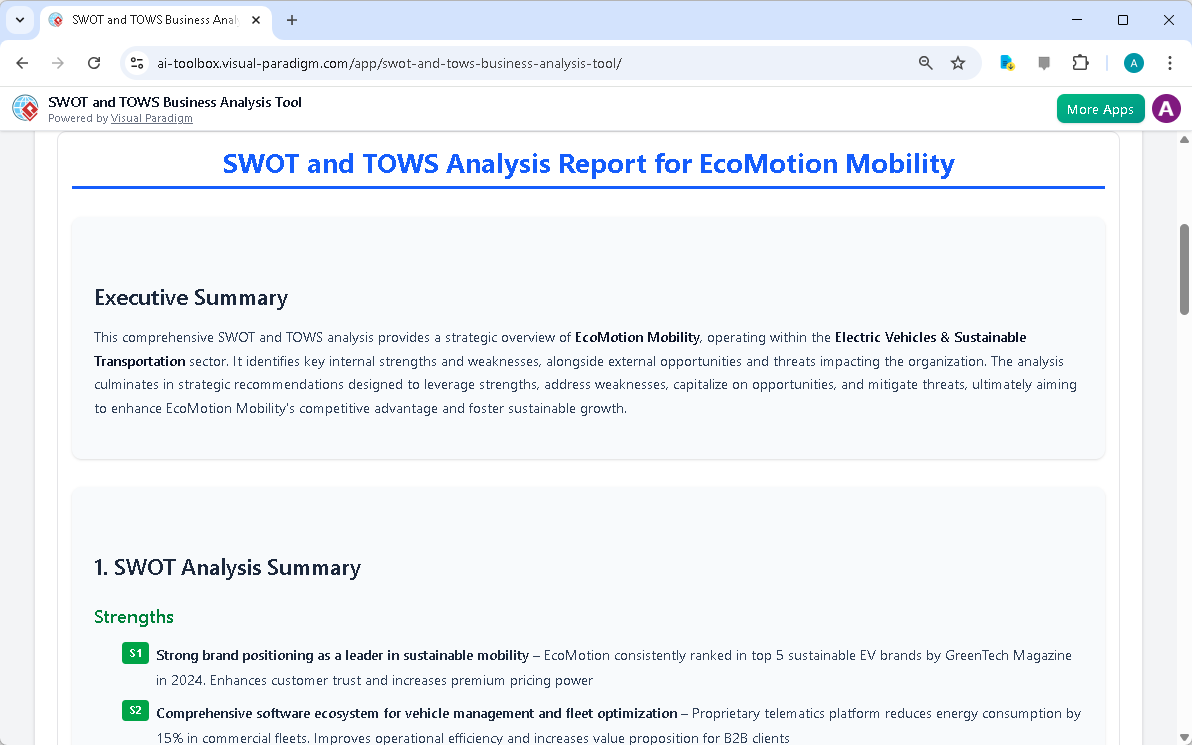
Finally, you reach Step 6: The Final Report. This is the culmination of your work. The tool generates a professional, easy-to-read report that summarizes your entire analysis. It includes an executive summary and a detailed breakdown of your SWOT and TOWS strategies. You can print it or save it as a PDF to share with your team. It’s a powerful way to present your strategic thinking in a clear, professional format.
Using this AI-Powered SWOT-TOWS Business Analysis Tool is a game-changer. It takes the guesswork out of strategic planning and provides a clear, structured path to developing a robust business strategy. Whether you’re an entrepreneur, a business manager, or a consultant, this tool can help you make better decisions and plan for a more successful future. Ready to create your own strategic plan? Try the tool now and see how easy it is to turn your business vision into a concrete plan.
Related Links
- AI-Powered SWOT and TOWS Business Analysis Tool: This tool leverages artificial intelligence to assist users in conducting SWOT and TOWS analyses for strategic business planning.
- SWOT Analysis: A Definitive Guide to AI-Powered Strategic Planning: Learn what SWOT Analysis is and see how AI helps you generate deeper insights, create TOWS strategies, and turn strategic planning into a fast, data-driven, and continuous process.
- Free AI SWOT & TOWS Analysis Tool for Strategic Planning …: Move from analysis to action with our free AI SWOT & TOWS analysis tool. A step-by-step guide to identify your strengths and weaknesses, and formulate powerful strategies.
- How SWOT-TOWS Analysis Works in Business: Stop creating static SWOT lists. This guide explains how our tool uses the powerful TOWS matrix to bridge the gap between analysis and action.
- SWOT-TOWS Business Analysis Archives – Visual Paradigm AI: A SWOT analysis is a powerful tool, but its effectiveness hinges on the accuracy of your external scan. Simply listing opportunities and threats isn’t …
- The Core Difference: SWOT vs. TOWS – Visual Paradigm AI: November 6, 2025 – Its purpose is to take the descriptive data from your SWOT analysis and transform it into a set of actionable strategies . It does this by pairing up the four SWOT categories to formulate four types of strategies: SO (Strengths-Opportunities): …
Related posts:
 Creating a Comprehensive Logistics Value Chain Analysis with AI
 How to Benchmark Netflix Against Disney+ and Amazon Prime with AI
 Strategic Analysis Redefined: Conducting a Comprehensive Tesla SWOT Assessment using the AI-Powered Four Aspects Infographic Designer
 Visualize the Ride-Sharing Industry in Minutes with AI-Powered Infographic Designer