




Architecting a Hospital Management System Database Using DB Modeler AI
Learn how to design a robust Hospital Management System database using DB Modeler AI. Automate SQL schema, ERDs, and 3NF normalization in seven steps.
Designing a complex database for a healthcare environment is a daunting task that requires extreme precision, yet the best AI-powered database modeling tool makes this process surprisingly calm and manageable. By utilizing the innovative DB Modeler AI from Visual Paradigm Online, you can transform a simple text description into a fully functional, normalized SQL schema without the usual stress associated with manual data architecture. This intelligent platform guides you through a logical progression, ensuring that your business requirements for a Hospital Management System are accurately reflected in every technical artifact generated along the way.
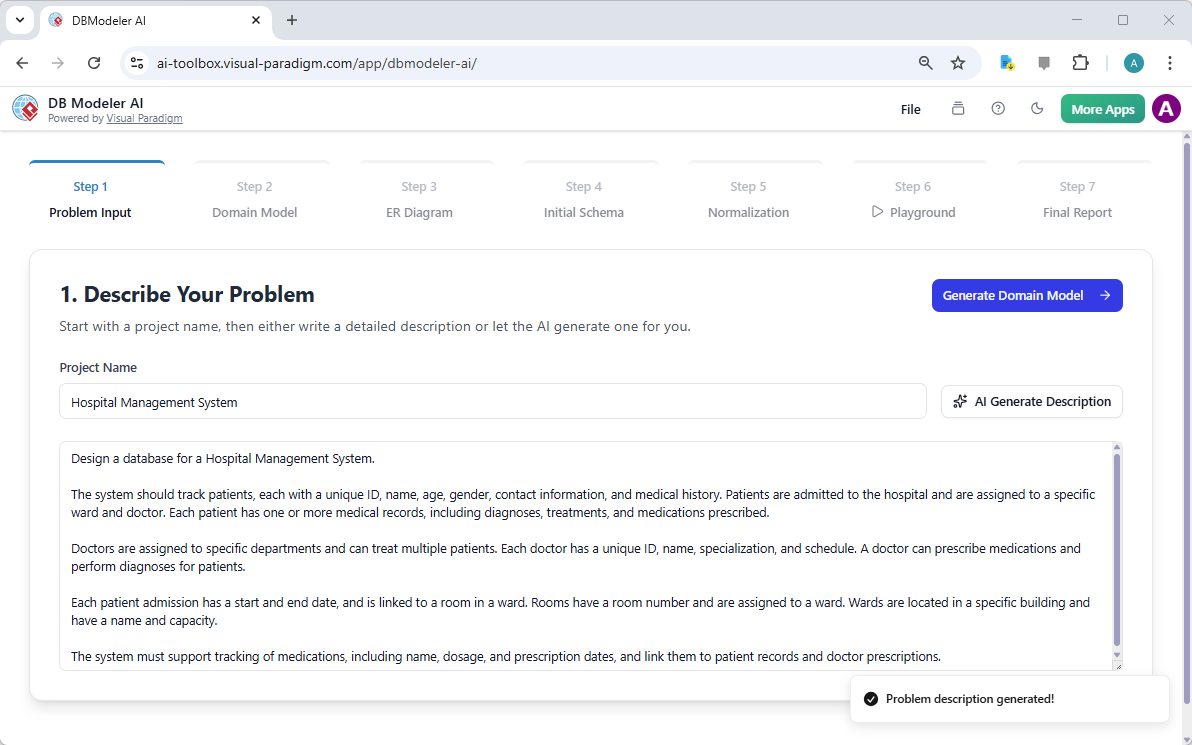
The journey begins with a clear definition of the problem scope, where the AI assistant helps you outline the necessary entities such as patients, doctors, and medical records. In the first step of the workflow, you simply provide a project name and a brief description, or you can even allow the AI to draft a comprehensive problem statement for you based on your initial idea. This foundational step ensures that all stakeholders have a shared understanding of the system’s goals before any technical diagrams are even considered or produced.
Key Takeaways for Efficient Database Design
-
Automated Workflow: Seamlessly transition from business descriptions to technical SQL code in seven guided steps.
-
Visual Clarity: Generate professional Domain Class Diagrams and Entity-Relationship Diagrams (ERD) automatically to visualize complex data connections.
-
Data Integrity: Utilize AI-assisted normalization to reach the Third Normal Form (3NF), effectively reducing data redundancy and potential errors.
-
Risk-Free Testing: Use the interactive playground to validate your schema with real data entries before moving to a production environment.
-
Comprehensive Reporting: Download a full design report that documents every stage of the modeling process for your development team.
Transforming Requirements into Domain Models
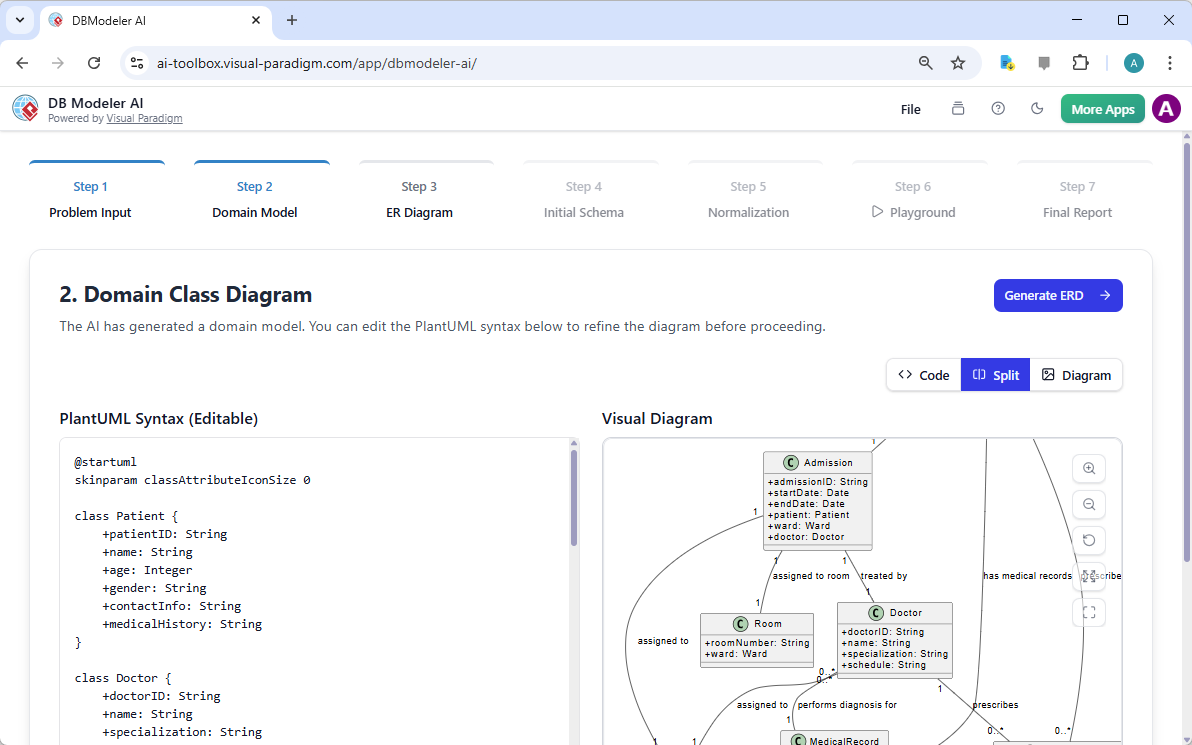
Once your problem description for the Hospital Management System is established, this easy-to-use online database design software moves to the second phase: creating a Domain Class Diagram. This conceptual model identifies the primary business entities, such as Admissions, Wards, and Doctors, while defining how they interact with one another in a real-world scenario. The AI interprets your text and generates a visual map using PlantUML syntax, which provides a high-level overview that is accessible to both developers and non-technical project managers alike.
The beauty of this step lies in its ability to clarify abstract concepts into tangible structures, allowing you to see if the relationship between a patient and their medical history is correctly captured. You have the flexibility to edit the generated syntax directly if you need to refine specific attributes or class names, ensuring the design remains perfectly aligned with your vision. This visual representation serves as a critical bridge, preventing the common disconnect that often occurs between initial business planning and the subsequent technical implementation phase.
Refining Logic with Automated ER Diagram Generation
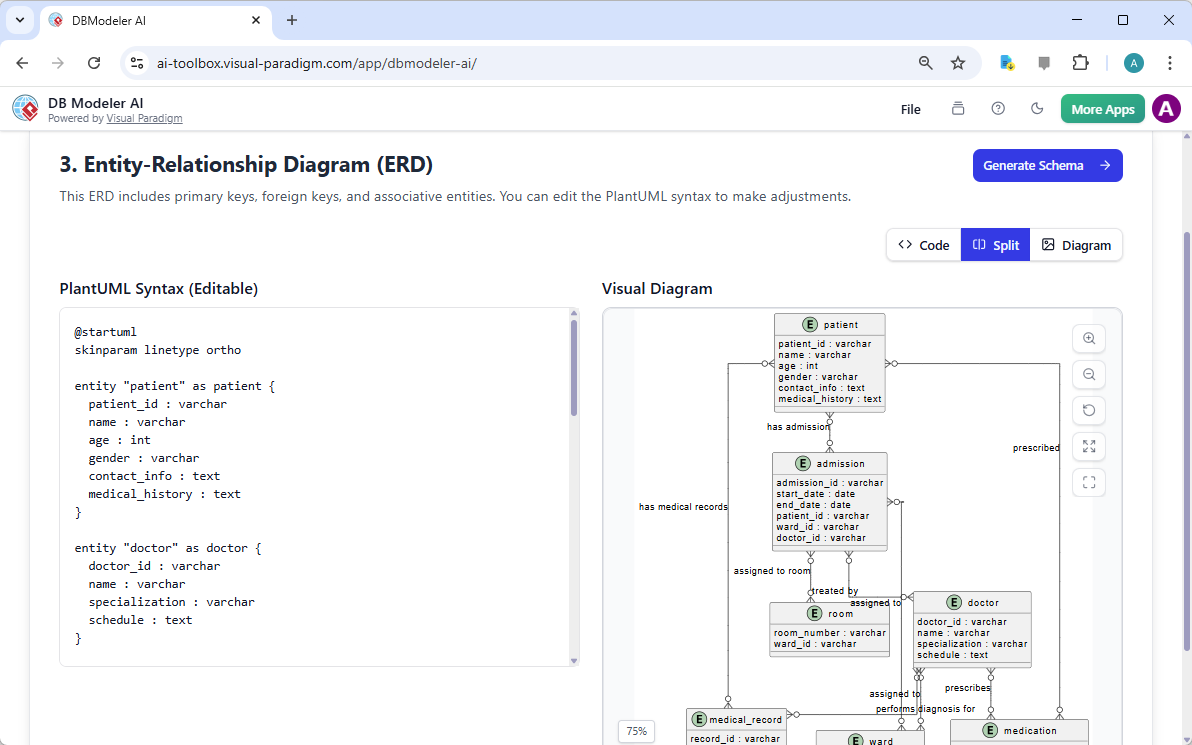
Moving deeper into the technical requirements, the third step involves the generation of a detailed Entity-Relationship Diagram, or ERD, which serves as the logical blueprint for your database. This professional ER diagram generator takes the classes defined in the previous step and adds the necessary database-specific details, such as primary keys, foreign keys, and associative entities. For a Hospital Management System, this means clearly mapping how a specific doctor is assigned to a ward and how patient admissions link back to available room numbers.
The resulting diagram is not just a static image but a logical framework that dictates how data will be stored and retrieved efficiently within your application. By automating this stage, DB Modeler AI minimizes the risk of architectural flaws that could lead to data inconsistencies or performance bottlenecks later in the development cycle. You can confidently review the connections between entities, ensuring that every piece of data has a logical home and that the relationships correctly support your system’s operational needs.
Generating SQL DDL and Advancing to Normalization
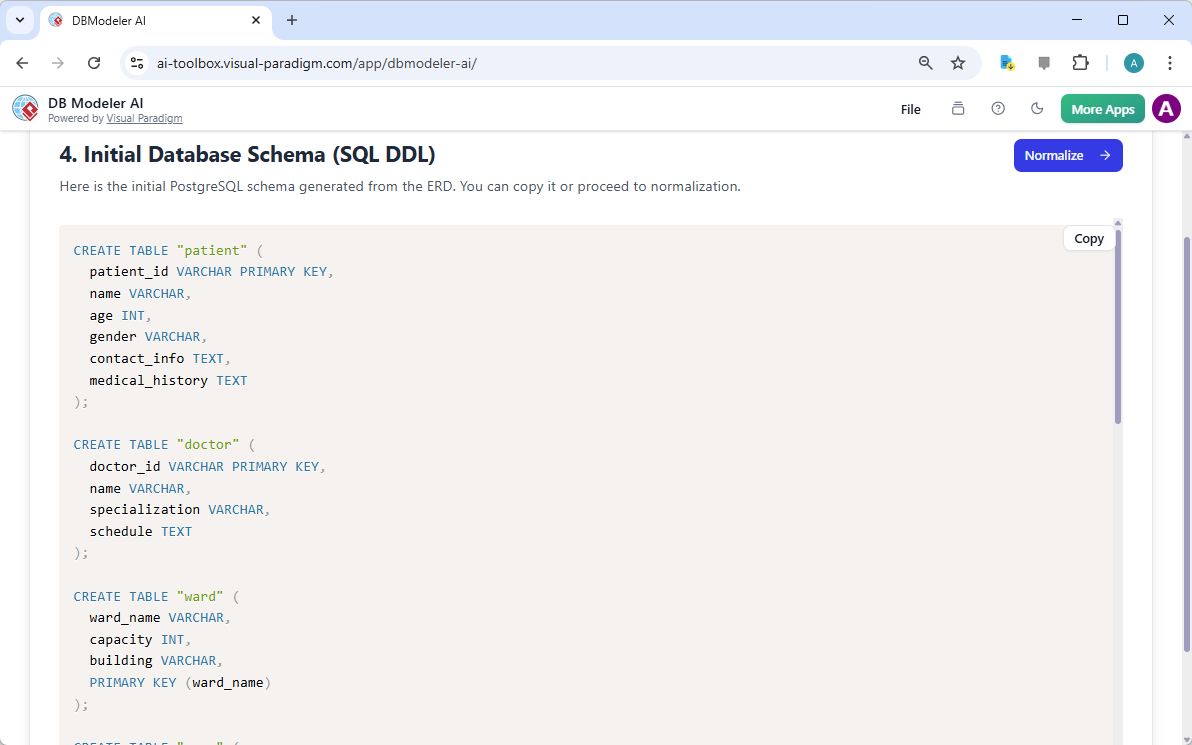
With a solid logical model in place, the AI-powered database modeling tool proceeds to generate the actual SQL Data Definition Language (DDL) necessary to build the database. In step four, the software produces a clean, structured PostgreSQL schema based on the confirmed ERD, providing the code for creating tables like “patient,” “doctor,” and “medical_record.” This automation saves hours of manual coding and ensures that the syntax is perfect, allowing you to focus on the broader application logic rather than the minutiae of table creation.
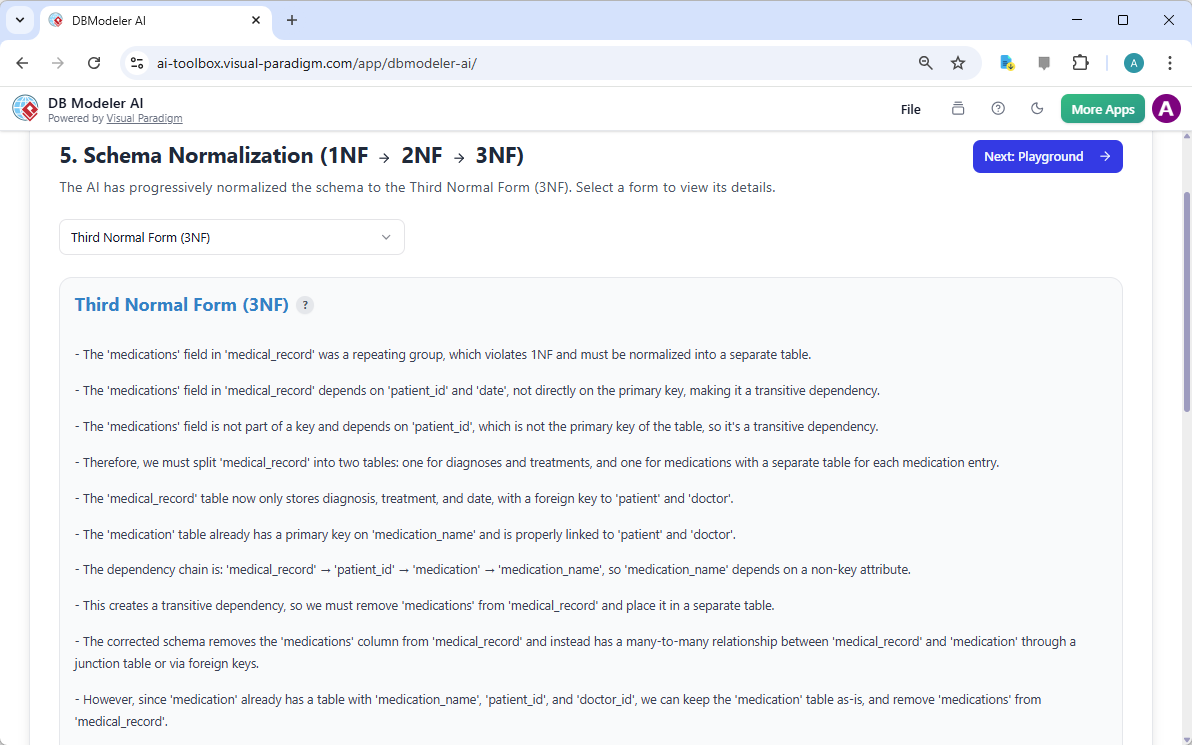
However, an initial schema is rarely perfect, which is why the fifth step of the process focuses on the critical task of schema normalization. The AI analyzes your initial design and applies standard rules to reach the Third Normal Form (3NF), identifying and resolving issues like repeating groups or transitive dependencies. For instance, it might suggest splitting a “medical_record” table to separate medication details, thereby enhancing data integrity and ensuring your Hospital Management System remains scalable and robust as patient data grows over time.
Live Testing in the Interactive Schema Playground
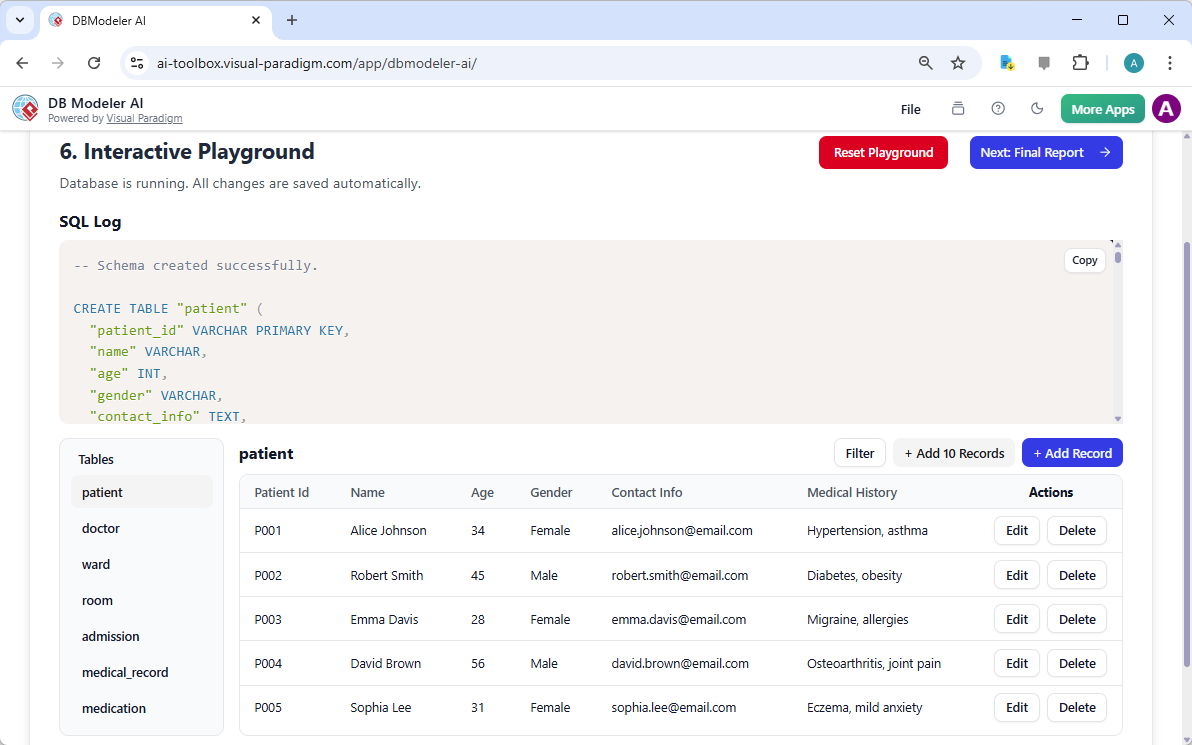
One of the most innovative features of this professional online DB modeler is the interactive playground found in the sixth step of the guided wizard. This environment provides a safe sandbox where you can actually interact with your generated schema by adding sample records for patients and doctors to see how the system behaves. As you perform actions like creating, retrieving, or updating data, the tool displays the related SQL statements on the screen, providing a transparent look at the underlying database operations.
This hands-hearted approach to validation allows you to catch potential issues before they ever reach your actual server, providing a level of reassurance that is rare in traditional design tools. By testing scenarios such as admitting a new patient to a specific ward or prescribing medication through the interface, you can verify that the relationships you designed are functioning exactly as intended. This step reduces the anxiety of deployment, as you have already seen your database structure successfully handle real-world data interactions in a simulated environment.
Professional Documentation and Final Design Reports
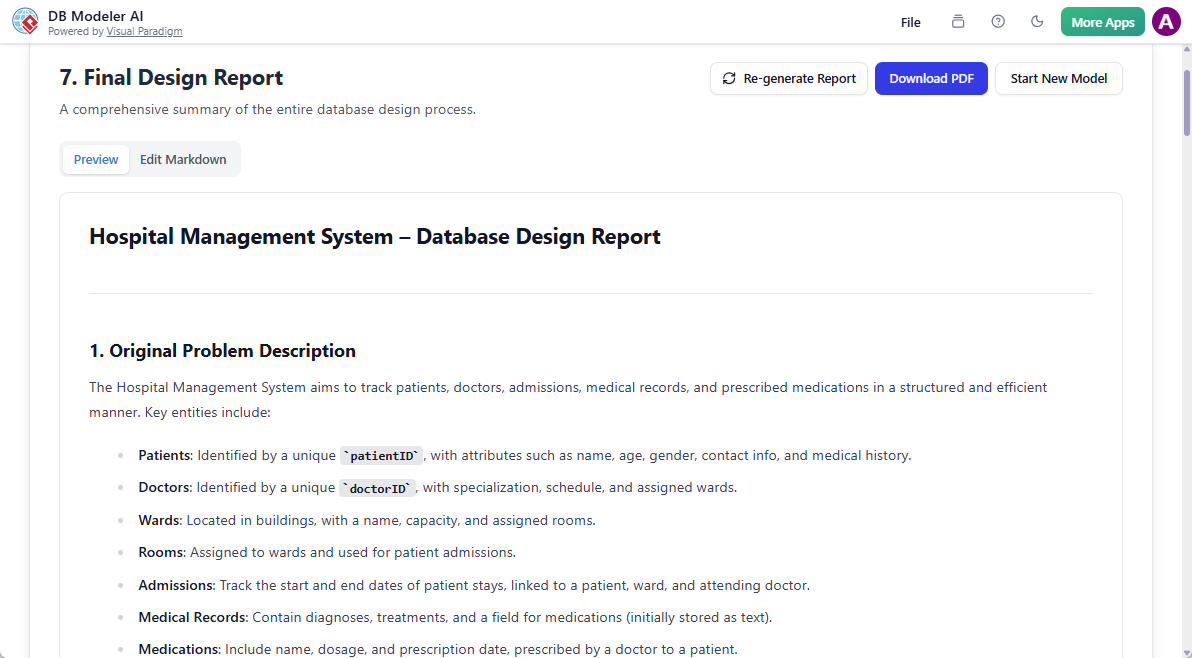
The final stage of the journey involves the generation of a comprehensive Design Report, which summarizes every artifact and decision made during the modeling process. This report includes the original problem description, the visual diagrams, the normalized SQL schema, and the logic behind the structural choices made by the AI. Having such a document is invaluable for maintaining consistency across a development team and providing clear documentation for future maintenance or system audits.
In conclusion, the best AI-powered database modeling tool from Visual Paradigm Online completely revolutionizes how we approach data architecture for complex projects like a Hospital Management System. By breaking down a complicated process into seven manageable, AI-assisted steps, DB Modeler AI ensures that your database is not only built quickly but is also optimized for performance and integrity. Whether you are a seasoned database administrator or a software developer looking to prototype a new idea, this tool provides the guidance and automation necessary to succeed with total confidence.
If you are ready to experience a smoother, more intelligent way to design your data structures, we invite you to explore the capabilities of this platform today. Start by visiting the DB Modeler AI information page to learn more about its extensive features. When you are prepared to begin your next project, you can try the DB Modeler AI tool now and see how quickly your vision can become a reality.
Related Links
Visual Paradigm provides a comprehensive suite of ERD (Entity-Relationship Diagram) tools that facilitate the design of scalable database schemas through both traditional visual editors and AI-driven automation. These tools support various notations, such as Chen notation, and enable the seamless transition from conceptual modeling to physical database implementation and reverse engineering.
-
Visual Paradigm ERD Tool – Create Entity-Relationship Diagrams Online: A web-based tool that enables the intuitive drag-and-drop design of professional database schemas.
-
Database Design with ERD Tools – Visual Paradigm Guide: A resource for architects focused on building scalable and robust databases using data modeling best practices.
-
DBModeler AI: Intelligent Database Modeling Tool: An AI-driven application designed for automated database modeling, schema generation, and live SQL testing.
-
Free ERD Tool – Design Databases Online with Visual Paradigm: Offers a no-installation, browser-based solution for creating professional entity-relationship diagrams at no cost.
-
Chen Notation ERD Editor – Advanced Entity-Relationship Modeling: A specialized editor providing full support for entities, attributes, relationships, and cardinality using precise Chen notation.
-
Visual Paradigm ERD Tool for Database Design – Complete Solution: A comprehensive tool for developers and architects to model, visualize, and generate databases with high efficiency.
-
New Diagram Types Added to AI Diagram Generator: DFD & ERD: This release highlights the ability to generate ERDs instantly from natural language prompts using AI.
-
Streamlining Entity-Relationship Modeling with Visual Paradigm: An article detailing how to simplify the modeling process from the initial concept to final database deployment.
-
Introduction to Data Modeling: ERD, Code Generation & Reverse Engineering: An introductory guide covering the essential lifecycle of diagramming and reverse engineering databases.
-
What is an Entity-Relationship Diagram (ERD)? – Visual Paradigm Guide: An explanatory guide covering the core components and significance of ERDs within the broader context of database design.
Related posts:
 Designing a Robust Online Bookstore Schema: A Step-by-Step Guide with DB Modeler AI
 Building a Smart Online Bookstore Schema: The Fast Path with DB Modeler AI
 Creating a UML State Diagram in Seconds with Visual Paradigm
 Architecting a Digital Education Hub with the AI-powered Use Case Driven Development Assistant